How to Clean a Bike Chain Properly
By Cal WhitmoreUpdated 8 min read
The short answer
Backpedal the chain through a degreaser-soaked brush, scrub the rollers, rinse with as little water as you can and dry it fully. Re-lube one drop per roller, wait a few minutes, then wipe the outside off.
Key takeaways
- The lube that matters is inside the rollers. Everything on the outside just collects grit — wipe it off.
- A dry chain wears fastest, but an over-lubed chain wears almost as fast because it holds grinding paste against the pins.
- You rarely need to remove the chain. On-bike cleaning is nearly as effective and far less risky.
- Never let degreaser reach disc rotors or pads. Cover them, or take the wheel out.
A chain is the fastest-wearing part on a bike and the one most exposed to everything the road throws at it. It is also, structurally, a long series of small plain bearings: each pin turns inside a bushing under load, thousands of times a mile. Grit that gets in there does not just make noise — it grinds the pins down and lengthens the chain, and a worn chain then wears the sprockets it runs on.
Cleaning is therefore not cosmetic. It is the difference between replacing a chain and replacing a chain, cassette and chainrings.
How often
| Riding | Clean | Why |
|---|---|---|
| Dry roads, summer | Every 200–300 miles | Dust builds slowly; a wipe-and-relube between cleans is enough |
| Mixed / commuting | Every 100–150 miles | Road grime accumulates faster than you notice |
| Wet or salted roads | Every ride, briefly | Salt and water strip lube and start corrosion within a day |
| Gravel or trail | After every dusty or muddy ride | Abrasive grit is the whole problem |
| Any ride ending in rain | Wipe and re-lube same day | Water displaces lube from the rollers |
Cleaning on the bike
This is what you will do ninety per cent of the time. It takes about ten minutes and does not require breaking the chain.
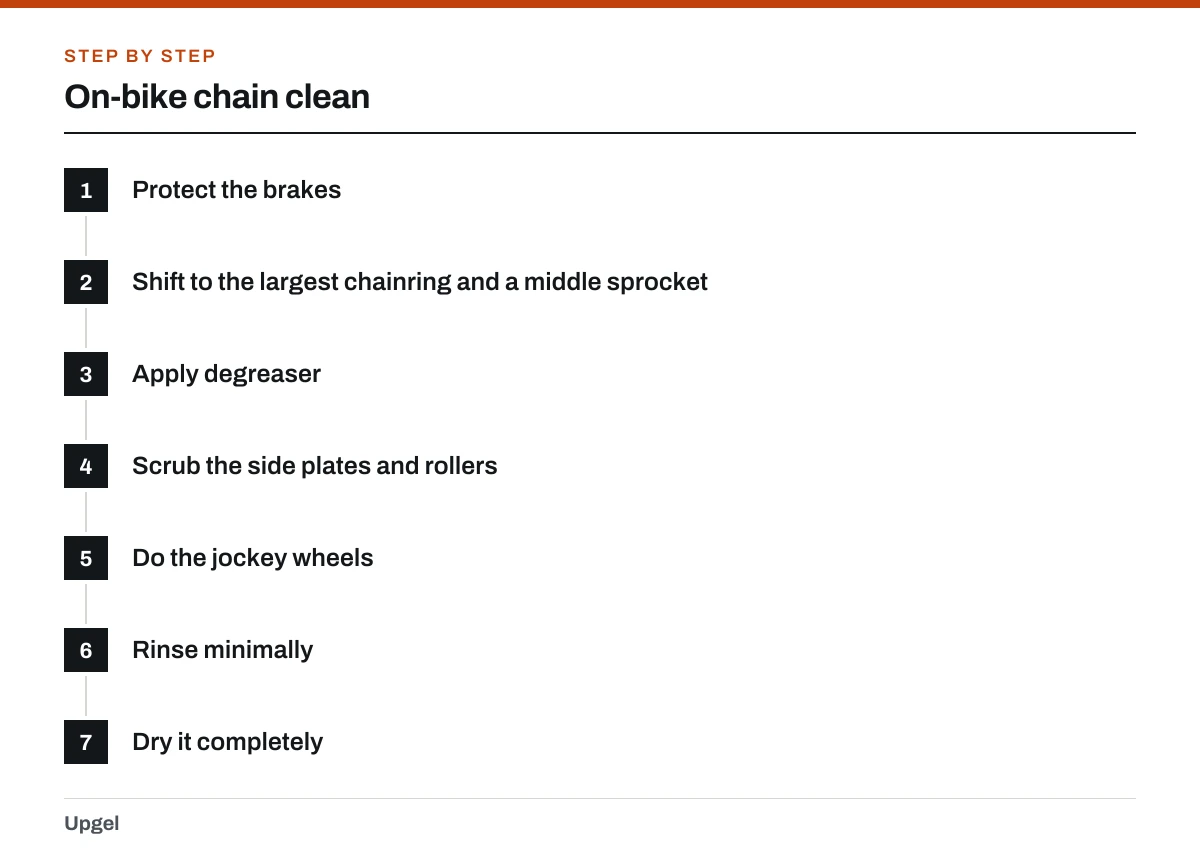
On-bike chain clean
Protect the brakes
On disc brakes, remove the wheel or bag the rotor. Degreaser on a rotor or pads costs you a set of pads — see cleaning brake rotors.
Shift to the largest chainring and a middle sprocket
This straightens the chain and gives you the best access.
Apply degreaser
Either into a chain-cleaning tool clipped over the lower run, or onto a stiff brush. Backpedal thirty or forty revolutions.
Scrub the side plates and rollers
A stiff brush along the top, bottom and both sides. Pay attention to the rollers themselves rather than just the shiny outer plates.
Do the jockey wheels
The two small pulleys on the rear derailleur collect a black paste that is mostly worn chain. Clean them with a rag corner or an old toothbrush.
Rinse minimally
A light spray or a wet rag. Never a pressure washer — it drives water and grit straight into the bearings.
Dry it completely
Backpedal through a dry rag until the rag stops coming away grey. A wet chain flash-rusts within hours.
Removing the chain to clean it
Taking the chain off and shaking it in a bottle of degreaser gets it cleaner than any on-bike method. It also means repeatedly breaking and rejoining the chain, and a quick link has a limited number of cycles in it. It is worth doing occasionally, not routinely.
- Only practical if your chain has a quick link. Removing a pinned chain with a chain tool each time weakens it — the method is in removing a bike chain.
- Shake the chain in a sealed bottle with degreaser for a minute, then repeat with clean degreaser until it runs clear.
- Rinse, then dry thoroughly. A hair dryer or an hour on a radiator is not overkill.
- Re-lube generously before refitting, because you have stripped everything including what was inside the rollers.
- Many quick links are single-use. Check the maker's guidance and keep spares.
Re-lubing correctly
This is where most people undo their own work. The job of lube is to sit between the pin and the bushing inside each link. Any lube on the outside of the chain does nothing useful and actively attracts dust, which is why a shiny wet-looking chain is usually a badly maintained one.
Lubing after a clean
Make sure it is bone dry
Lube will not displace water properly. If in doubt, wait longer.
One drop per roller
Work along the lower run, backpedalling slowly, placing a single drop on each roller. Aerosols are wasteful and get everywhere, including your rotor.
Backpedal for thirty seconds
This works the lube into the rollers and distributes it evenly.
Wait five minutes
Most lubes need time for the carrier to penetrate and then flash off.
Wipe all the outside off
Firmly, with a clean rag, until the chain looks almost dry. What is inside stays inside. This single step is what stops a clean chain going black in fifty miles.
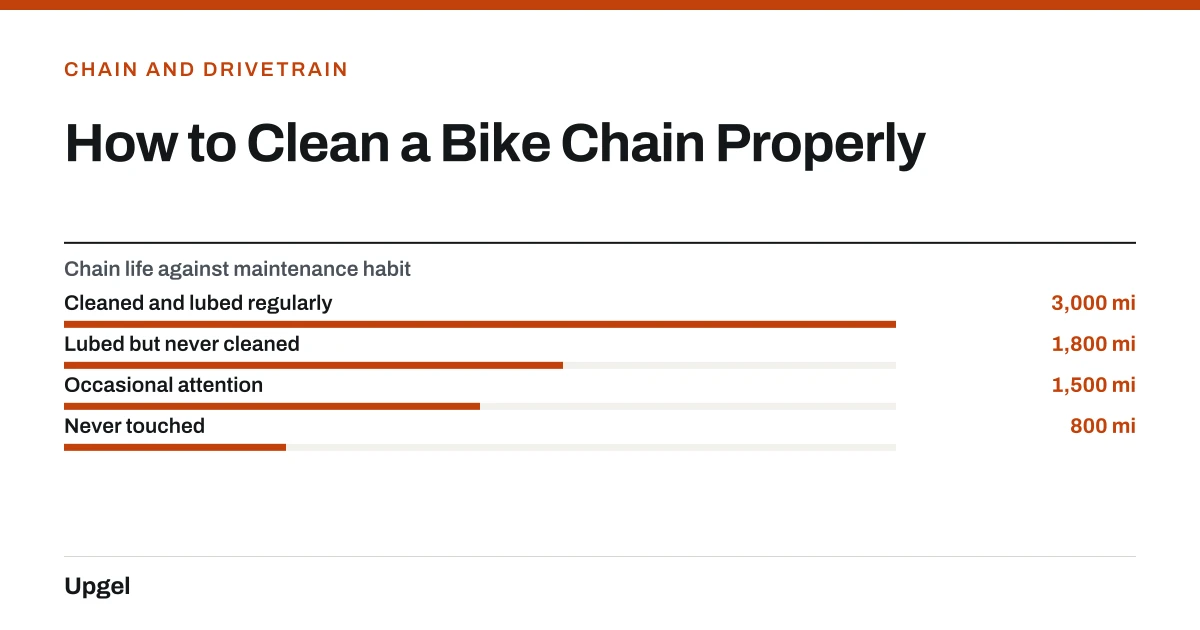
- Cleaned and lubed regularly3,000mi
Regular light maintenance is the whole story.
- Lubed but never cleaned1,800mi
Lube plus grit makes grinding paste.
- Occasional attention1,500mi
The common case.
- Never touched800mi
And it takes the cassette with it.
While you are there
A chain clean is a natural moment to check two other things. First, chain wear — a worn chain should be replaced before it damages the cassette, and replacing a bike chain covers sizing the new one. Second, the cassette itself, which collects the same grime between its cogs; cleaning a bike cassette deals with that.
Frequently asked questions
How often should I clean my bike chain?
Every 200–300 miles in dry conditions, every 100–150 for commuting, and after every wet or gritty ride. A same-day wipe and re-lube after rain matters more than a deep clean.
Can I clean a bike chain without removing it?
Yes, and it is the better routine option. A chain-cleaning tool or a stiff brush with degreaser while backpedalling gets most of the benefit without repeatedly breaking the chain.
What can I use to clean a bike chain?
A dedicated bike degreaser is best. Avoid petrol, brake cleaner and other aggressive solvents, which strip the factory lubricant from inside the rollers where you cannot easily replace it.
Should I wipe the chain after lubing?
Yes, thoroughly. The lubricant that matters is inside the rollers. Anything left on the outside only collects grit, which is what wears the chain in the first place.
Sources
- Chains — Sheldon Brown
Supports: Chain construction as pin-and-bushing bearings, wear mechanics, and why lubricant belongs inside the rollers.
- Effects of the Nonlinear Elastic Behavior of Bicycle Chain on Transmission Efficiency — Journal of Applied Mechanics · DOI 10.1115/1.4007431
Supports: That chain condition and behaviour under load measurably affect transmission efficiency.
- A novel model for bicycle drivetrain efficiency — Sports Engineering · DOI 10.1007/s12283-025-00505-8
Supports: That drivetrain losses depend on load and configuration, so efficiency gains from cleaning are modest compared with durability gains.