How Often to Lube a Bike Chain
By Cal WhitmoreUpdated 7 min read
The short answer
Lube roughly every 100 to 150 miles in the dry, every 50 to 75 in the wet, and after any ride in rain. Better than any schedule: if the chain looks dry or sounds dry, it needs lube regardless of mileage.
Key takeaways
- Conditions matter more than mileage. One wet ride strips more lube than three hundred dry miles.
- Wet lube lasts longer and attracts more grit; dry and wax lubes stay cleaner but need reapplying sooner.
- Over-lubing is a real failure mode, not just waste. Surplus lube on the outside holds abrasive grit against the chain.
- Always wipe the outside off after lubing. The lube doing the work is inside the rollers where you cannot see it.
There is no single correct interval, which is annoying when that is exactly what people want. What there is instead is a small set of rules that get you close, and one test that beats any schedule: look at the chain and listen to it.
Intervals by conditions and lube
| Conditions | Wet lube | Dry lube | Wax |
|---|---|---|---|
| Dry roads, summer | 150–200 mi | 100–150 mi | 100–150 mi |
| Mixed commuting | 100–150 mi | 75–100 mi | 75–100 mi |
| Wet or salted roads | 50–75 mi | Not suitable | Not suitable |
| Dusty gravel or trail | Attracts grit badly | 75–100 mi | 60–100 mi |
| After any ride in rain | Same day | Same day | Re-wax needed |
Choosing a lube type
- Wet lube is oil-based and stays put in rain. It is the right choice for winter and wet climates. It also attracts and holds dust, so it needs cleaning more often — see cleaning a bike chain.
- Dry lube carries a light lubricant in a solvent that evaporates, leaving a drier film. Much cleaner in dust, but washes off quickly in rain.
- Wax-based lube goes on wet and dries to a solid film that sheds grit rather than holding it. The cleanest option by a distance, and the most demanding: it needs a properly degreased chain to start, and reapplying more often.
- Hot-melt wax means immersing the chain in molten wax. Excellent results and the longest chain life, but it requires removing the chain every time — practical only with a quick link, as covered in removing a bike chain.
- Do not use general-purpose spray oils or water-displacing sprays as chain lube. They are too thin to stay in the rollers under load.
Applying it properly
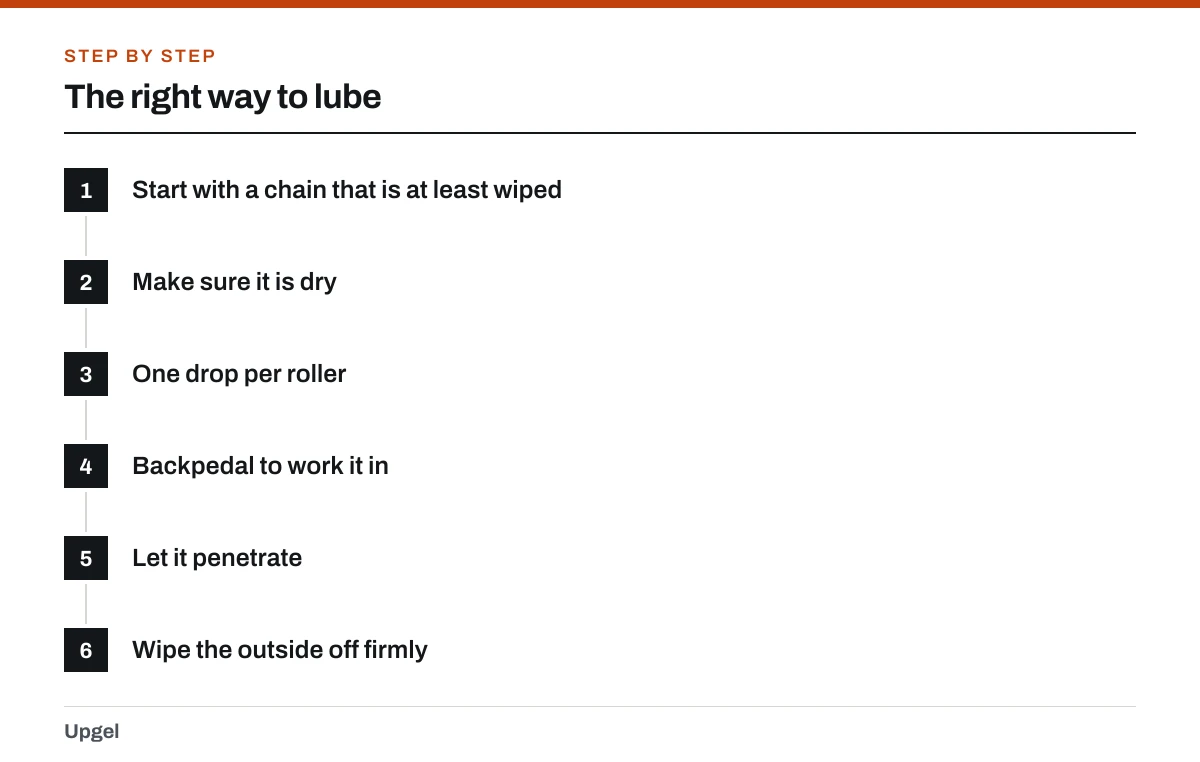
The right way to lube
Start with a chain that is at least wiped
Lubing over grit just makes wet grinding paste. Wipe the chain through a rag first, and degrease it properly if it is genuinely dirty.
Make sure it is dry
Lube cannot displace standing water from inside the rollers.
One drop per roller
Backpedal slowly and place a single drop on each roller of the lower run. Aerosols overspray onto rims, rotors and the floor.
Backpedal to work it in
Thirty seconds of slow backpedalling distributes it through the links.
Let it penetrate
Five minutes for most lubes; check the bottle. Wax lubes often want an hour or overnight to harden fully.
Wipe the outside off firmly
Until the chain looks almost dry. This is the step that separates a clean drivetrain from a black one.
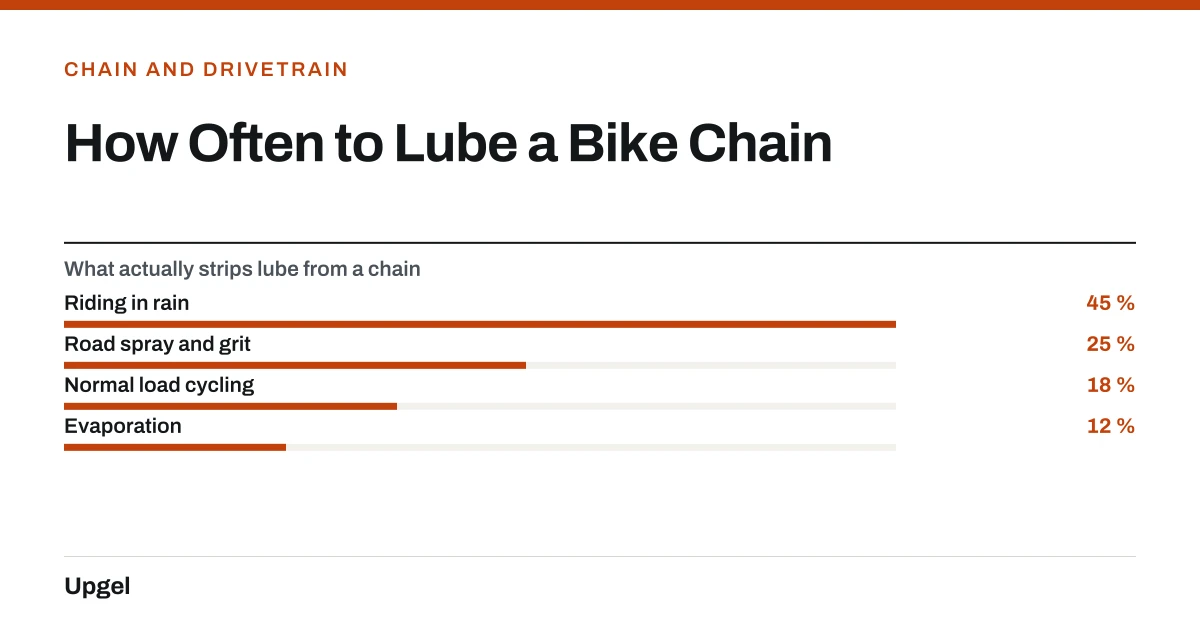
- Riding in rain45%
Water displaces lube from the rollers directly.
- Road spray and grit25%
Abrasion carries lube out with it.
- Normal load cycling18%
Lube is squeezed out under pedalling force.
- Evaporation12%
Mostly affects solvent-carried dry lubes.
Signs you are getting it wrong
| What you see | What it means |
|---|---|
| Squeaking or rustling | Under-lubed. Lube now; do not wait for the next ride. |
| Thick black paste on the outside | Over-lubed, or not wiped after lubing. Degrease and start again. |
| Orange rust film after a wet ride | Chain was left wet. Wipe, dry and lube same day. |
| Chain looks clean and dull grey | Correct. This is what a well-kept chain looks like. |
| Grit visible between the plates | Needs cleaning before any more lube goes on. |
If the chain is already noisy, skipping and shifting badly, lube may not be the answer at all — a worn chain behaves that way regardless. Replacing a bike chain covers checking wear and sizing a new one, and fixing a bike chain deals with stiff links and skipping.
Frequently asked questions
How often should I lube my bike chain?
Roughly every 100–150 miles in dry conditions and every 50–75 in wet or gritty ones, plus same-day after any ride in rain. Judge by how the chain looks and sounds rather than by mileage alone.
Can you over-lubricate a bike chain?
Yes. Surplus lube on the outside of the chain attracts dust and grit and holds it against the rollers, which can wear the chain faster than running it slightly dry.
What is the best type of chain lube?
Wet lube for rain and winter, dry lube for dusty summer conditions, wax for the cleanest drivetrain if you are willing to reapply more often and degrease properly first.
Should I lube my chain after every ride?
No, only after wet rides or when the chain looks or sounds dry. Lubing an already-lubricated chain just builds up surplus on the outside that collects grit.
Sources
- Chains — Sheldon Brown
Supports: That lubricant belongs inside the roller bearings, and the wear consequences of grit held against the pins.
- A novel model for bicycle drivetrain efficiency — Sports Engineering · DOI 10.1007/s12283-025-00505-8
Supports: That drivetrain efficiency differences from lubrication state are real but modest under typical loads.
- Effects of the Nonlinear Elastic Behavior of Bicycle Chain on Transmission Efficiency — Journal of Applied Mechanics · DOI 10.1115/1.4007431
Supports: That chain state under load affects transmission efficiency measurably.