How to Remove a Bike Chain
By Cal WhitmoreUpdated 7 min read
The short answer
If the chain has a quick link, squeeze the two outer plates towards each other and it pops apart. If it is pinned, push a rivet out with a chain tool — and on Shimano chains use a new joining pin to rejoin it.
Key takeaways
- Find out first whether you have a quick link. It changes the whole job and takes ten seconds to check.
- Count your links before you break the chain. Getting the length back is far harder than taking it apart.
- A pin you have pushed out and pushed back is a weak link. Shimano chains require a new joining pin every time.
- Shift to the smallest chainring and smallest sprocket first — it slackens the chain and makes everything easier.
Removing a chain is one of those jobs that is trivial or annoying depending entirely on one thing: whether the chain has a quick link. Spend ten seconds finding out before you reach for a tool, because the two methods have almost nothing in common.
Do you have a quick link?
Backpedal slowly and watch the chain. A quick link — also called a master link, PowerLink, missing link or KMC link depending on the maker — looks visibly different from the links either side of it. The outer plates are a slightly different shape, often a different colour, and each has a keyhole-shaped slot rather than two round holes.
| Quick link | Pinned | |
|---|---|---|
| How to spot it | One odd-looking link with keyhole slots | Every link identical |
| Tool needed | Quick-link pliers, or a loop of cable | Chain tool |
| Reusable? | Often, but check — many are single-use | Shimano: no, needs a new pin. Others: usually reusable |
| Time | Under a minute | Three to five minutes |
| Risk | Losing the link on the floor | Bending a plate or misaligning the pin |
Removing a quick link
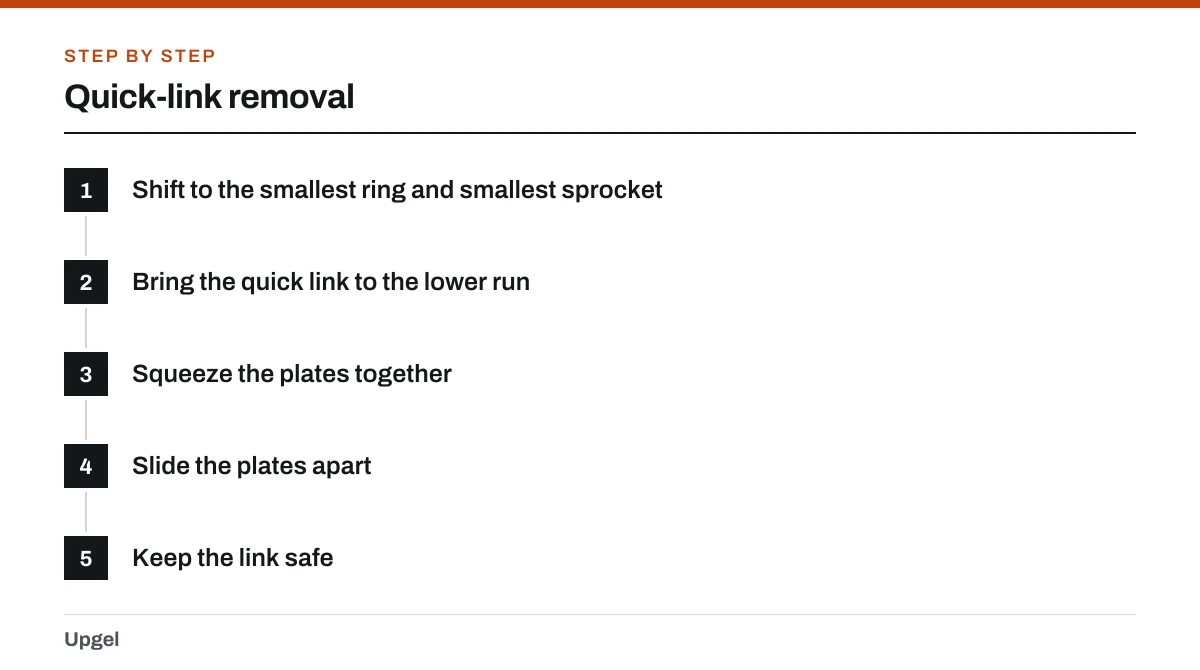
Quick-link removal
Shift to the smallest ring and smallest sprocket
This gives the chain maximum slack and takes tension off the derailleur.
Bring the quick link to the lower run
Position it on the straight section between the chainring and the rear derailleur, where you can get both hands to it.
Squeeze the plates together
Quick-link pliers grip the two pins and push them towards each other, which lines the pins up with the wide part of the keyholes.
Slide the plates apart
Once the pins are in the wide section, the link slides open. Without pliers, loop a short length of old brake cable through the two links either side and pull the ends together — it does the same job.
Keep the link safe
It is small, black and lands in gravel. Put it straight in a pocket or a tub.
If you have no pliers and no cable, there are a few workarounds using string, zip ties or a pair of pliers — those are covered in removing a bike chain without a chain tool.
Removing a pinned chain
A chain tool is a small clamp with a threaded pin driver. It holds a chain link in a cradle while you wind a hardened pin against the chain's rivet, pushing it out of the plates.
Using a chain tool
Pick your link
Choose a link on the lower run, away from the quick link if there is one and away from any stiff or damaged links.
Seat the chain in the tool
Most chain tools have two cradles. Use the one further from the driver for pushing pins out; the near cradle is for loosening a stiff link afterwards.
Line the driver up exactly
The driver pin must sit precisely on the centre of the chain rivet. Off-centre pressure bends the side plate and ruins the link.
Wind the pin out
Turn the handle steadily. On most chains, stop when the rivet is nearly out but still held in the far plate — that leaves something to push back into.
Shimano chains: push it all the way out
Shimano specify a new joining pin for reassembly. Push the old rivet right out and discard it; do not attempt to reuse it.
Flex the chain apart
A gentle sideways flex separates the plates once the pin is clear.
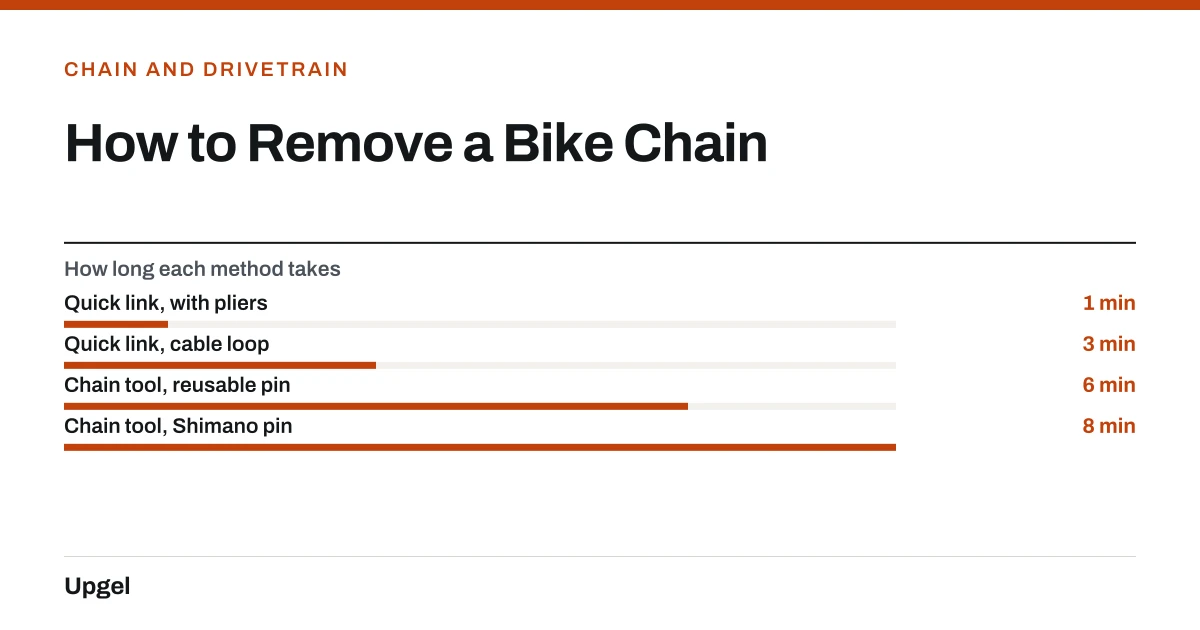
- Quick link, with pliers1min
The reason to fit one.
- Quick link, cable loop3min
No special tool needed.
- Chain tool, reusable pin6min
Plus freeing the stiff link afterwards.
- Chain tool, Shimano pin8min
Includes fitting and snapping off the new pin.
The stiff link problem
After pushing a pin back in, the link it joins is often stiff — it will not flex freely, and it produces a rhythmic skip once per chain revolution as it refuses to bend around the jockey wheels. Fix it by placing that link in the near cradle of the chain tool and winding the driver in a fraction, which spreads the plates very slightly. Alternatively flex the chain sideways by hand either side of the link.
If the skipping continues afterwards, the cause is probably not the link. Fixing a bike chain covers skipping, broken links and roadside repairs, and a worn chain skips regardless of how well it is joined.
The most common cause of chain breakage is a badly installed rivet.
Sheldon Brown, Chains
Frequently asked questions
How do I know if my bike chain has a quick link?
Backpedal slowly and look for one link whose outer plates differ from the rest — usually a different colour or finish, with keyhole-shaped slots instead of two round holes.
Can I remove a bike chain without a chain tool?
Yes, if it has a quick link. A loop of old brake cable or a pair of pliers will squeeze the plates together. A pinned chain genuinely needs a chain tool.
Can you reuse a bike chain pin?
Not safely. Pushing a rivet out deforms the plate hole, so the rejoined link is weaker than the rest of the chain. Shimano chains specifically require a new joining pin each time.
Why does my chain skip after I rejoined it?
Usually a stiff link at the join. Put that link in the near cradle of the chain tool and wind the driver in slightly to spread the plates, or flex the chain sideways by hand.
Sources
- Chains — Sheldon Brown
Supports: Chain tool technique, why a reused rivet makes a weak joint, and the stiff-link fix using the near cradle.
- Effects of the Nonlinear Elastic Behavior of Bicycle Chain on Transmission Efficiency — Journal of Applied Mechanics · DOI 10.1115/1.4007431
Supports: That chain link articulation under load affects transmission behaviour, which is why a stiff link causes a repeating skip.
- Bicycle Tools — Sheldon Brown / Harris Cyclery
Supports: Chain tool design, including the two cradle positions and their separate functions.