Remove a Bike Chain Without a Chain Tool
By Cal WhitmoreUpdated 6 min read
The short answer
Without a chain tool you can only open a chain that has a quick link. Loop old brake cable, a shoelace or two zip ties through the links either side and pull the ends together until the link pops open.
Key takeaways
- This works on quick-link chains only. There is no safe improvised way to push a rivet out of a pinned chain.
- The cable-loop trick is the most reliable improvisation and uses something most riders already carry.
- Pliers work but slip easily. Squeeze along the axis of the pins, not across the plates.
- Do not hammer, grind or drill a rivet. You will destroy the chain and probably the frame paint.
There is a hard limit worth stating immediately: without a chain tool, you can only separate a chain at a quick link. A pinned chain holds its plates together with press-fit rivets, and there is no improvised method that pushes one out without wrecking the chain. If your chain has no quick link and you have no tool, the honest answer is that this job waits.
First, check for a quick link
Backpedal slowly and watch each link pass. A quick link stands out: its two outer plates are usually a different colour or finish from the rest, and each carries a keyhole-shaped slot rather than two plain round holes. Most chains sold in the last decade either come with one or have had one fitted at some point.
The cable loop method
This is the most reliable improvisation and it works because it does exactly what quick-link pliers do: pull the two links either side of the quick link towards each other, which slides the pins into the wide part of the keyholes.
Using a cable, lace or zip ties
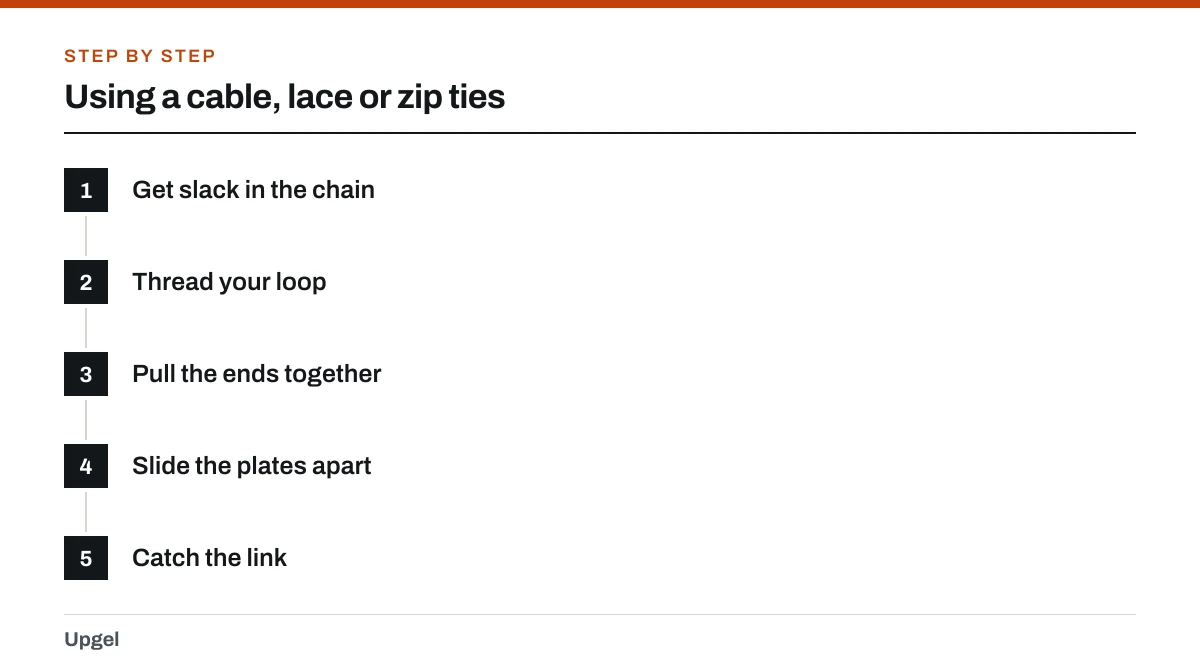
Get slack in the chain
Shift to the smallest chainring and smallest sprocket. Bring the quick link onto the lower run where you can reach it.
Thread your loop
Push a length of old brake cable, a shoelace, strong cord or two interlocked zip ties through the chain two links to the left of the quick link, and two links to the right.
Pull the ends together
Grip both ends and pull firmly. The two sides of the quick link are forced towards each other.
Slide the plates apart
While holding that compression, push the outer plates in opposite directions along the chain. The pins move into the wide part of the keyholes and the link opens.
Catch the link
It comes apart suddenly. Have a hand or a pocket ready — quick links are small, dark and very easy to lose in grass.
Other methods that work
| Method | How well it works | Watch out for |
|---|---|---|
| Old brake cable loop | Best improvisation | Nothing much — this is the one to use |
| Shoelace or strong cord | Works well | Thin cord cuts into fingers; wrap it round something |
| Two zip ties interlocked | Works | Cheap ties snap under the load |
| Two pairs of pliers | Works with care | Slipping and pinching your hand; grip the pins, not the plates |
| One pair of pliers, squeezing | Sometimes | Easy to bend a plate if you grip across it |
| Bare hands | Occasionally on worn links | A link that opens by hand is too worn to trust |
Getting it back together
Refitting a quick link needs no tools at all, which is the other half of why they are worth having. Slot both pins through the wide part of the keyholes, then pull the chain apart hard along its length until the pins slide into the narrow section and the link clicks.
- If pulling by hand is not enough, put the chain in a mid-gear, hold the rear brake, and stand gently on a pedal. That applies far more force than your hands can.
- Check the link is flush and flat with the plates either side.
- Flex it — it must articulate as freely as its neighbours. A stiff join produces a skip once per revolution, covered in fixing a bike chain.
- Run through every gear slowly by hand before riding.
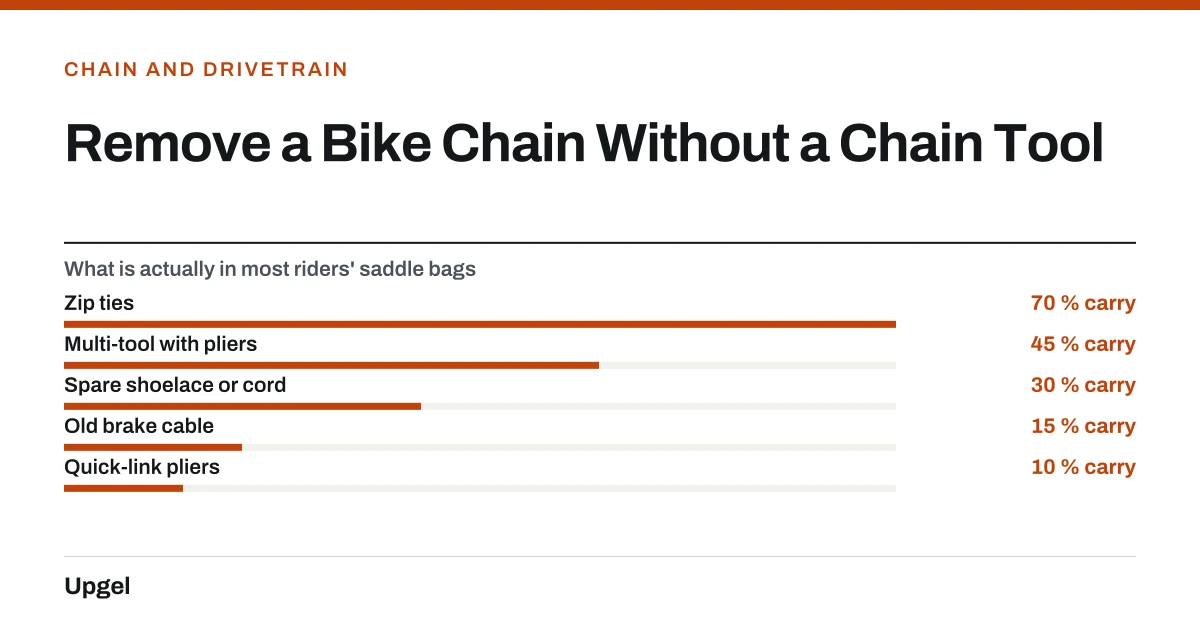
- Zip ties70% carry
Two interlocked will usually do it.
- Multi-tool with pliers45% carry
Works, with care about grip.
- Spare shoelace or cord30% carry
Underrated. Wrap the ends to save your fingers.
- Old brake cable15% carry
The best option, and near weightless.
- Quick-link pliers10% carry
The proper tool, and tiny.
If you are doing this to clean the chain, note that on-bike cleaning avoids the whole problem — cleaning a bike chain covers it. And if you are shortening rather than just removing, you will need a proper tool regardless: see removing a chain link.
Frequently asked questions
Can you remove a bike chain without a chain tool?
Only if it has a quick link. Loop a cable, lace or zip ties through the links either side and pull them together to open it. A pinned chain requires a chain tool.
How do I open a quick link without pliers?
Thread a loop of old brake cable or strong cord through the chain two links either side of the quick link, pull the ends together to compress it, then slide the outer plates apart.
Can I break a bike chain with pliers?
You can open a quick link with pliers if you grip along the pins rather than across the plates. You cannot safely push a rivet out of a pinned chain with them.
Are quick links reusable?
It depends on the brand — some are explicitly single-use. Replace any link that opens too easily or no longer clicks positively into place.
Sources
- Chains — Sheldon Brown
Supports: Quick link and master link operation, and why press-fit rivets on pinned chains require a proper tool.
- Bicycle Tools — Sheldon Brown / Harris Cyclery
Supports: The function of a chain tool and why improvised rivet removal damages side plates.
- Derailer Adjustment — Sheldon Brown
Supports: Shifting to the smallest ring and sprocket to obtain maximum chain slack before working on it.