How to Put a Bike Chain Back On
By Cal WhitmoreUpdated 6 min read
The short answer
Shift to the smallest chainring, lift the chain onto the bottom of that ring by hand, then turn the cranks forward slowly and it will climb back on. If it keeps dropping, the limit screws are set wrong.
Key takeaways
- You almost never need tools. Lift the chain onto the ring and pedal forward — the drivetrain does the rest.
- Do not force the cranks with the chain jammed. That is how chainring teeth get bent and stays get scratched.
- A chain that drops repeatedly is a limit screw problem, not bad luck.
- Chain drops off the inside land between the ring and the frame; drops off the outside land against the crank arm.
A dropped chain is the most common mechanical on a bike and the least serious. It happens when the front derailleur pushes the chain past the edge of a chainring, usually during a shift under load or on a bumpy section. Nothing is broken. The chain is simply sitting beside the ring instead of on it.
The thirty-second fix
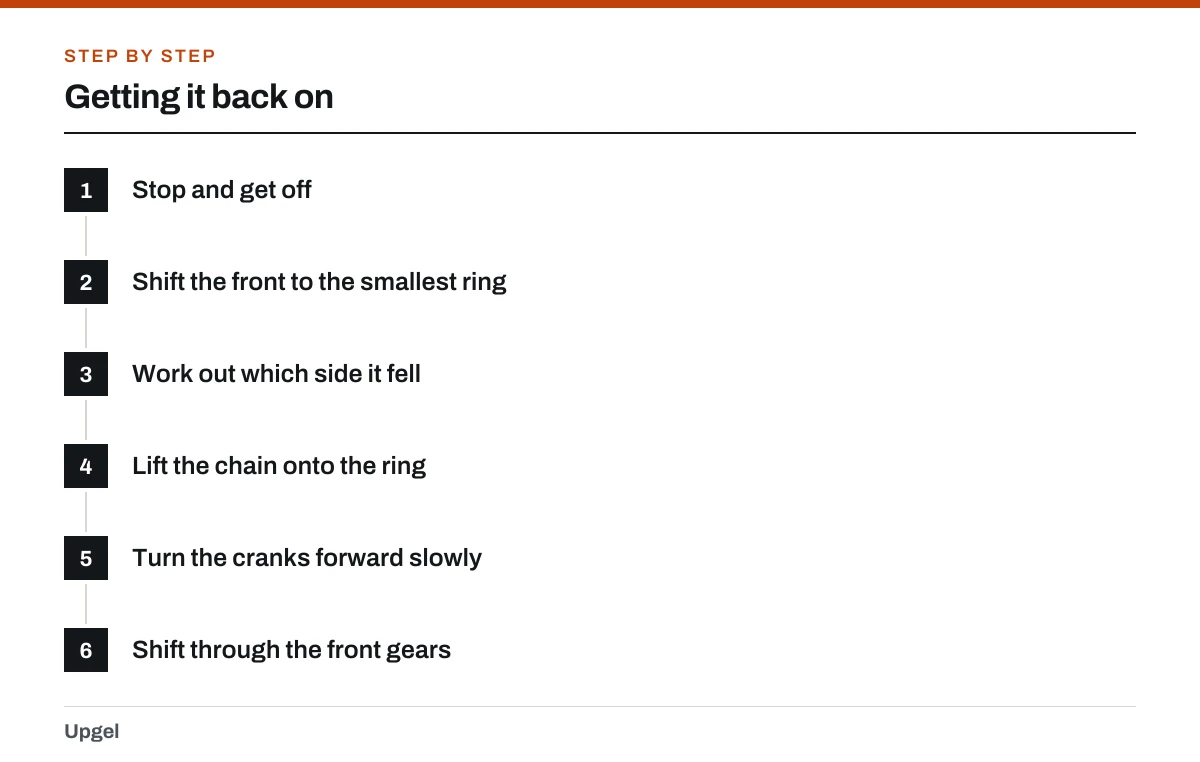
Getting it back on
Stop and get off
Do not try to pedal it back on under load. If the chain is jammed, forcing the cranks bends teeth.
Shift the front to the smallest ring
Move the left shifter to its lowest position. The derailleur cage swings inboard, which is where you want it.
Work out which side it fell
Inside means it is between the small ring and the frame. Outside means it is resting against the crank arm, outboard of the big ring.
Lift the chain onto the ring
Take the lower run of chain and hook it over the teeth at the bottom of the smallest chainring. It only needs a few teeth engaged.
Turn the cranks forward slowly
Lift the rear wheel or hold the bike upright and rotate the pedals by hand. The chain climbs onto the ring on its own.
Shift through the front gears
Check it moves cleanly between rings before you get back on.
If it is properly jammed
Occasionally a chain does not just drop, it wedges — between the small ring and the frame, or between the big ring and the crank arm. Force makes this worse.
- Stop pedalling entirely. Any further force drives it in tighter.
- Create slack by pushing the rear derailleur cage forwards, towards the front of the bike. That releases the spring tension holding the chain taut.
- With the chain slack, ease it out by hand rather than levering it.
- If it will not come, remove the rear wheel to get more slack still — the method is in removing a rear bike wheel.
- Once free, check the chainring teeth for bends and the chain for damaged links, covered in fixing a bike chain.
Why it keeps happening
A chain that drops once is normal. A chain that drops regularly is telling you something specific: the front derailleur is allowed to travel further than the chainrings extend.
| Drops to the | Cause | Fix |
|---|---|---|
| Inside, towards the frame | Low limit screw (L) set too far out | Turn L clockwise a quarter turn at a time |
| Outside, towards the crank | High limit screw (H) set too far out | Turn H clockwise a quarter turn at a time |
| Either, only under hard effort | Shifting under load | Ease off the pedals through the shift |
| Either, on rough ground | Chain slack or worn chainring teeth | Check chain wear; consider a chain retainer |
| Only after a crash or transport | Bent derailleur or hanger | Check alignment before adjusting anything |
Setting the limit screws properly is a five-minute job and it is the actual cure. The full sequence — height, rotation, then the L and H limits — is in adjusting a front derailleur.
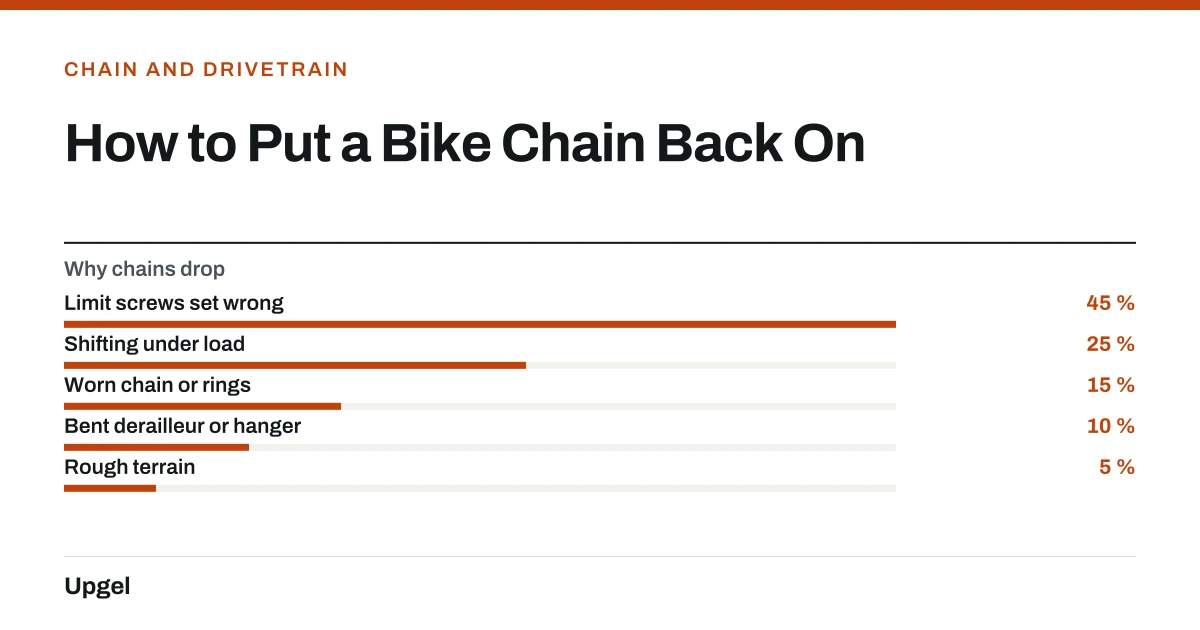
- Limit screws set wrong45%
The most common, and a five-minute fix.
- Shifting under load25%
Technique. Ease off through the shift.
- Worn chain or rings15%
Worn teeth hold the chain less securely.
- Bent derailleur or hanger10%
Check after any crash or airline transport.
- Rough terrain5%
A chain guide or clutch derailleur helps.
Preventing it
- Set the front derailleur limits correctly and re-check them once a season.
- Ease pedal pressure during a front shift. The chain has to climb sideways; it cannot do that reliably under full load.
- Avoid shifting the front ring on a bumpy descent or at the start of a steep climb.
- Keep the chain in good condition — a worn chain sits less securely on worn teeth. Check wear per replacing a bike chain.
- On gravel and mountain bikes, a chain retainer or a clutch rear derailleur makes a large difference on rough ground.
Frequently asked questions
How do I put a bike chain back on without tools?
Shift to the smallest chainring, hook the lower run of chain onto the bottom teeth of that ring by hand, then rotate the cranks forward slowly. The chain climbs on by itself.
Why does my bike chain keep falling off?
Usually the front derailleur limit screws let the cage travel further than the chainrings extend. Repeated inside drops mean the L screw needs turning in; outside drops mean the H screw does.
Can a dropped chain damage the bike?
Not by itself, but forcing the pedals with the chain jammed can bend chainring teeth and scratch through frame paint. Stop pedalling as soon as it drops.
What if the chain is stuck between the frame and chainring?
Push the rear derailleur cage forwards to release chain tension, which gives you slack to ease it out by hand. Removing the rear wheel gives more slack again if needed.
Sources
- Derailer Adjustment — Sheldon Brown
Supports: Front derailleur limit screw function and how L and H settings determine the cage's inner and outer travel.
- Chains — Sheldon Brown
Supports: Why worn chains and chainring teeth hold engagement less securely under load.
- Bicycle Tools — Sheldon Brown / Harris Cyclery
Supports: That a dropped chain needs no special tooling to refit, unlike chain removal.