How to Fix a Bike Chain
By Cal WhitmoreUpdated 8 min read
The short answer
For a snapped chain, remove the damaged link and its neighbour with a chain tool and rejoin with a quick link. For a stiff link, flex it sideways. Skipping under load usually means the chain is worn out.
Key takeaways
- A snapped chain almost always damages the links either side too. Remove a full inner-plus-outer pair, not just the broken piece.
- A shortened chain works to get you home, but avoid the largest chainring and largest sprocket while it is short.
- A rhythmic skip once per chain revolution is a stiff link. A skip under load in any gear is chain wear.
- Carry a quick link. It weighs nothing and it is the difference between riding home and walking.
"My chain is broken" covers four quite different problems, and they have four different fixes. Before doing anything, work out which one you have — the wrong repair on the right symptom wastes an afternoon.
| Symptom | Actual problem | Fix |
|---|---|---|
| Chain in two pieces | Snapped, usually at a plate | Remove damaged links, rejoin with a quick link |
| Regular skip, once per chain revolution | Stiff link | Flex it or spread the plates with a chain tool |
| Skips under load in several gears | Worn chain, probably worn cassette | Replace the chain, and likely the cassette |
| Chain fell off the chainring | Dropped chain | Lift it back on; check derailleur limits |
| Chain jammed between frame and ring | Chain suck or overshift | Free it carefully, then set the limit screws |
Fixing a snapped chain
Chains snap under sudden high load — a hard standing start, a clumsy shift under power, or a stick through the drivetrain. The break is almost never clean: the plates either side get bent or stretched even when they look intact.
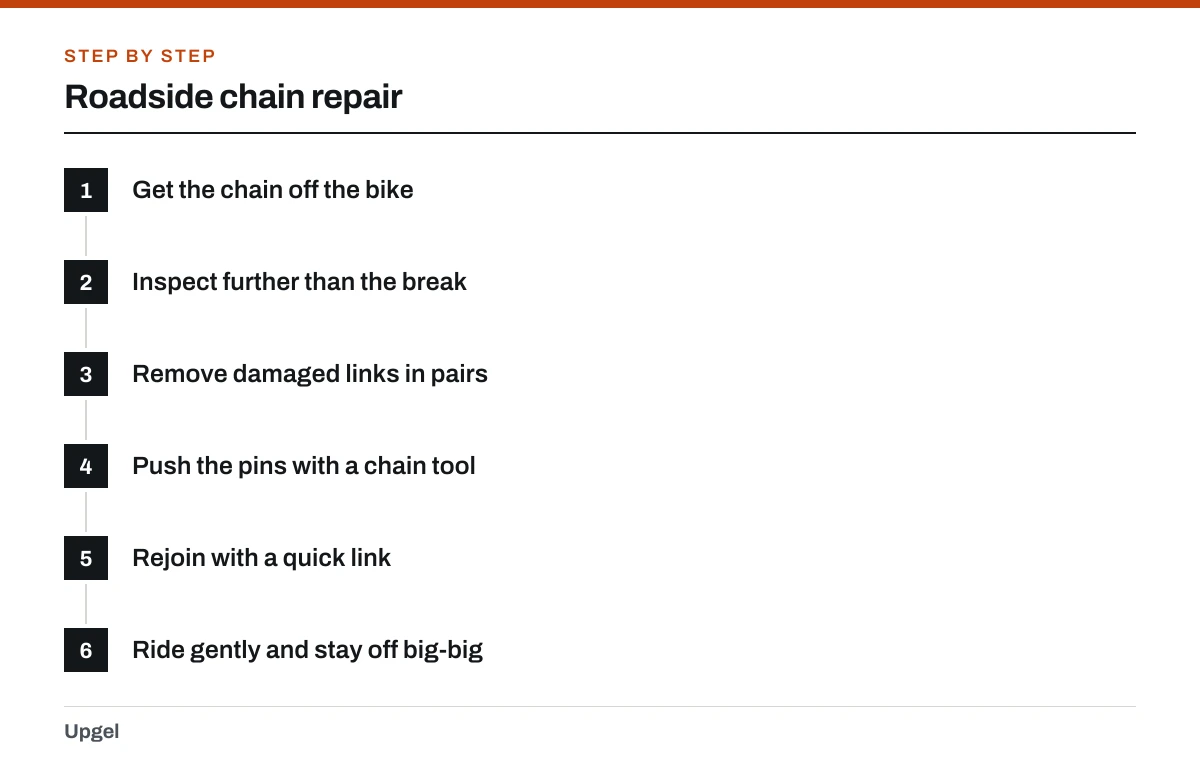
Roadside chain repair
Get the chain off the bike
Free it from the derailleur cage and lay it out where you can see both broken ends.
Inspect further than the break
Look at two or three links either side. Bent side plates, a link that will not flex freely, or a visibly widened plate hole all need to come out too.
Remove damaged links in pairs
A chain alternates inner and outer links. To rejoin it you need an inner link at one end and an outer at the other, so remove a full inner-plus-outer pair to keep the ends compatible.
Push the pins with a chain tool
Technique in removing a bike chain. On a multi-tool, take your time lining the driver up on the rivet centre.
Rejoin with a quick link
Slot it in, then pull the chain apart hard or stand on the pedal against the brake until it clicks.
Ride gently and stay off big-big
The chain is now two links shorter. The largest chainring with the largest sprocket may over-extend the derailleur.
Fixing a stiff link
A stiff link will not articulate freely. As it passes around the small radius of the jockey wheels it resists bending, and you feel a distinct regular tick or skip — always at the same interval, which is the giveaway.
Freeing a stiff link
Find it
Backpedal slowly and watch the chain pass through the rear derailleur. The stiff link visibly jumps rather than flowing around the jockey wheel.
Flex it sideways
Hold the chain either side of the link and flex laterally, both directions, a few times. This alone fixes most cases.
Or use the chain tool's near cradle
Seat the link in the cradle nearest the driver and turn the handle a fraction — this pushes the rivet very slightly and spreads the plates.
Check it before riding
The link should now bend as freely as its neighbours.
If it keeps returning
The rivet is probably damaged from a previous repair. Remove that link pair and rejoin with a quick link.
Skipping that is not a stiff link
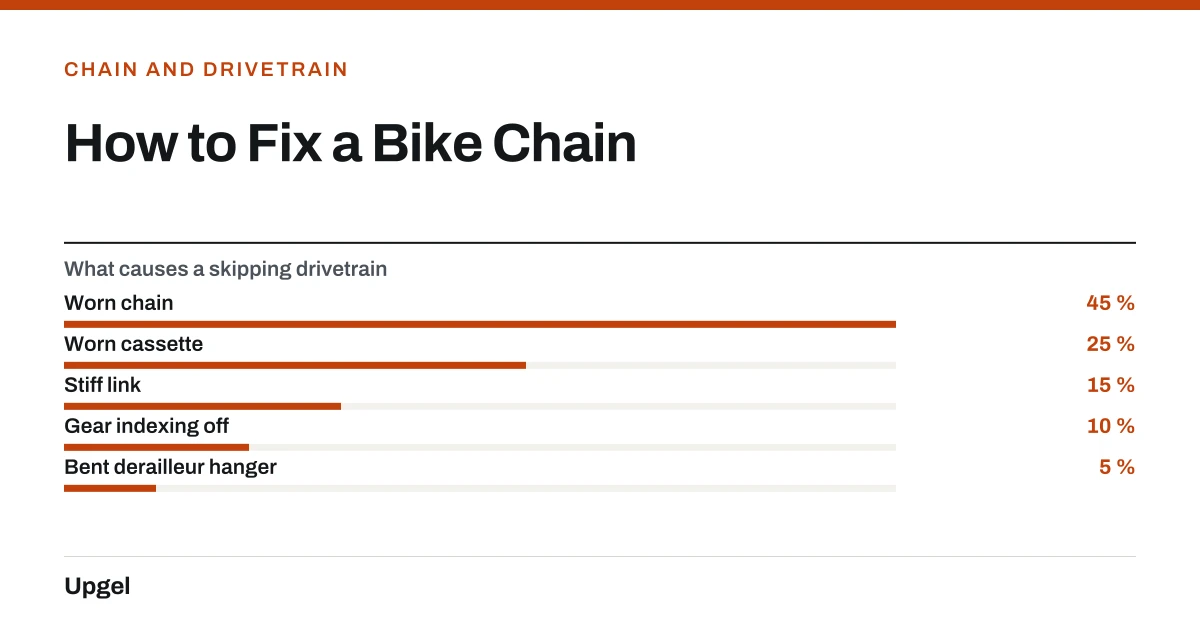
If the skip is irregular, happens under hard pedalling, and occurs in several gears, the chain is worn. Worn chains have a slightly longer pitch than new ones, so they ride up the sprocket teeth under load and jump.
- Worn chain45%
Measure it. Replace at 0.5% on 11-speed and above.
- Worn cassette25%
Usually because the chain was left too long.
- Stiff link15%
The one that is genuinely a quick fix.
- Gear indexing off10%
Feels like skipping but is really mis-shifting.
- Bent derailleur hanger5%
Check if the bike has been laid on its drive side.
A jammed or sucked chain
- Stop pedalling immediately. Forcing a jammed chain bends chainring teeth and can crack a frame stay.
- Shift pressure off by backpedalling gently rather than pulling hard.
- If the chain has wedged between the chainring and the frame, release the rear derailleur tension by pushing the cage forward, which gives you slack to work with.
- Chain suck — where the chain sticks to the chainring and gets dragged up and round — usually means worn chainring teeth or a dry, gritty chain.
- After freeing it, check the chainring teeth for damage and the limit screws, as covered in adjusting a front derailleur.
The most common cause of chain breakage is a badly installed rivet.
Sheldon Brown, Chains
Frequently asked questions
Can you fix a broken bike chain without a new link?
Yes, by removing the damaged links and rejoining the shortened chain. You still need a quick link or a joining pin to reconnect it — reusing the pushed-out rivet makes a weak joint.
Why does my chain skip once every rotation?
That regular interval points to a single stiff link. Flex the chain sideways at that link, or spread the plates slightly using the near cradle of a chain tool.
Is it safe to ride with a shortened chain?
To get home, yes, gently. Avoid the largest chainring with the largest sprocket, because a short chain can over-extend and destroy the rear derailleur in that combination.
Why does my chain keep breaking?
Most often a previous repair left a badly seated rivet, or the chain is worn out and the plates are fatigued. Check for a weak joint first, then measure chain wear.
Sources
- Chains — Sheldon Brown
Supports: Inner and outer link alternation when shortening, stiff-link remedies, and badly installed rivets as the main breakage cause.
- Derailer Adjustment — Sheldon Brown
Supports: That mis-indexed gears produce chatter easily mistaken for a skipping chain.
- Effects of the Nonlinear Elastic Behavior of Bicycle Chain on Transmission Efficiency — Journal of Applied Mechanics · DOI 10.1115/1.4007431
Supports: That link articulation under load determines how the chain engages sprocket teeth, explaining load-dependent skipping.