How to Adjust Bike Gears
By Cal WhitmoreUpdated 8 min read
The short answer
Most gear trouble is cable tension, cured by a quarter turn of the barrel adjuster. Before adjusting, work out which of four things is wrong: tension, cable friction, a limit screw, or a worn chain.
Key takeaways
- Diagnose first. Turning the barrel adjuster on a worn chain or bent hanger wastes an afternoon.
- Hesitant shifting up the cassette means not enough cable tension. Overshooting means too much.
- A problem in one specific gear at each extreme is a limit screw. A problem across all gears is cable, hanger or wear.
- New bikes and new cables both need re-indexing after a few hundred miles as the cable settles.
"My gears need adjusting" is usually true and usually incomplete. There are four separate things that produce bad shifting, they feel broadly similar from the saddle, and only one of them is fixed by the barrel adjuster everyone reaches for. Five minutes of diagnosis saves a lot of fiddling.
Work out what is actually wrong
| What it does | Most likely cause | Fix |
|---|---|---|
| Slow or hesitant shifting to larger sprockets | Not enough cable tension | Barrel adjuster, counter-clockwise |
| Shifts up too eagerly, noisy, overshoots | Too much cable tension | Barrel adjuster, clockwise |
| Will not reach the largest or smallest sprocket | Limit screw | Set L or H on the derailleur |
| Poor in every gear, gritty feel at the shifter | Cable friction or corrosion | New inner wire and housing |
| Skips under load in several gears | Worn chain, probably worn cassette | Replace — adjustment will not help |
| Chain rubs only in extreme combinations | Cross-chaining | Normal. Use the trim position or avoid it |
| Bad since a crash or a flight | Bent derailleur hanger | Straighten or replace the hanger |
Cable tension: the common case
Gear cables stretch, and housing beds in. On a new bike or after a new cable, this happens within the first few hundred miles and is entirely normal — it is why most shops offer a free first service.
Re-indexing with the barrel adjuster
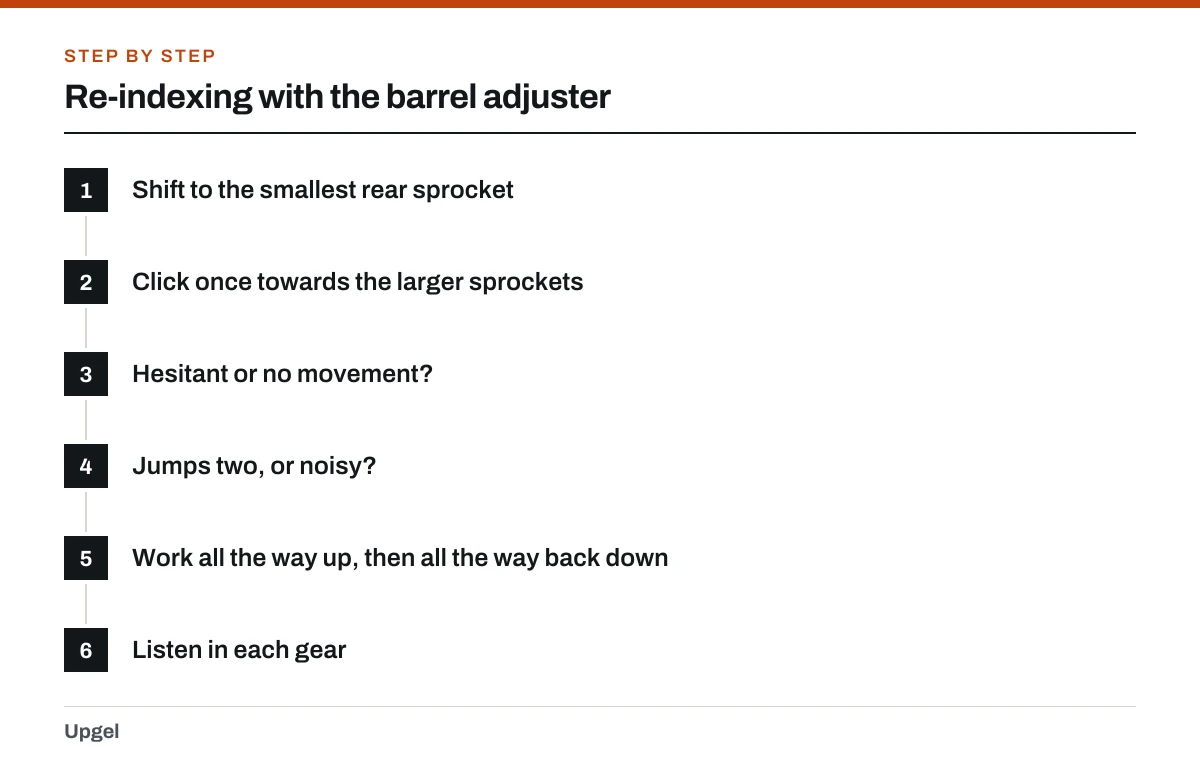
Shift to the smallest rear sprocket
Highest gear, least cable tension. Keep pedalling while you shift.
Click once towards the larger sprockets
Watch what the chain does.
Hesitant or no movement?
Not enough tension. Turn the barrel adjuster counter-clockwise a quarter turn and try again.
Jumps two, or noisy?
Too much tension. Turn it clockwise a quarter turn.
Work all the way up, then all the way back down
Downshifts can need slightly different tension from upshifts. Aim for a compromise where both are clean.
Listen in each gear
A quiet drivetrain in every gear is the target. A persistent rattle in one gear means you are a fraction of a turn out.
When it is friction, not tension
A corroded or gritty cable produces symptoms that look exactly like bad indexing, and no amount of tension adjustment fixes it, because the problem is that the cable moves inconsistently rather than that it moves the wrong amount.
- Tell-tale sign: shifting in one direction is fine, the other is sluggish. The derailleur spring can pull the cable back, but the shifter cannot push it through friction.
- Unhook the cable at the derailleur and pull it through by hand. It should slide with almost no resistance.
- Rust-coloured dust at the housing ends means the inner wire is corroding.
- Gear housing is different from brake housing — longitudinal strands for precision rather than a spiral. Use the right one; the process is otherwise the same as replacing a brake cable.
When it is the hanger
The derailleur hangs from a soft aluminium tab designed to bend before the frame does. It bends easily — laying the bike on its drive side, a light fall, or airline baggage handling will all do it. A bent hanger makes correct indexing across the full range impossible.
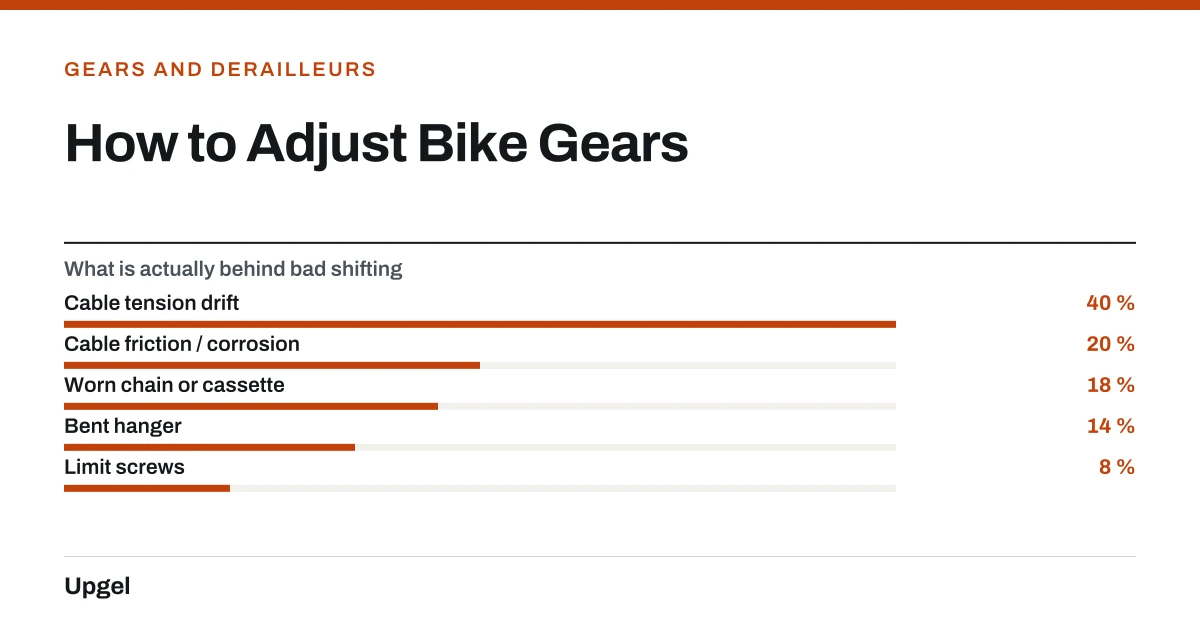
- Cable tension drift40%
The genuine barrel adjuster case.
- Cable friction / corrosion20%
Needs a new cable, not adjustment.
- Worn chain or cassette18%
Measure the chain before adjusting anything.
- Bent hanger14%
Nothing indexes properly until it is straight.
- Limit screws8%
Usually only after someone has been fiddling.
Working through the full setup
If re-indexing does not do it, work through each derailleur properly. The rear has four adjustments in a fixed order — hanger, B-tension, limits, cable — set out in adjusting a rear derailleur. The front is height, rotation, then limits, covered in adjusting a front derailleur.
The limit screws do not control shifting; they only limit the travel of the derailer.
Sheldon Brown, Derailer Adjustment
Frequently asked questions
Why are my bike gears not changing properly?
Most often cable tension has drifted, fixed with a quarter turn of the barrel adjuster. If shifting is bad across the whole range, suspect cable friction, a bent hanger, or a worn chain instead.
Which way do I turn the barrel adjuster?
Counter-clockwise increases cable tension and helps the chain move to larger sprockets. Clockwise reduces tension. Adjust a quarter turn at a time.
Can worn chains cause bad shifting?
Yes, and no adjustment will fix it. A chain past about 0.75% wear skips under load and will have worn the cassette to match, so both usually need replacing together.
How often do bike gears need adjusting?
New cables need re-indexing within the first few hundred miles as they settle. After that, once or twice a year is typical unless something gets knocked.
Sources
- Derailer Adjustment — Sheldon Brown
Supports: That limit screws bound travel rather than control shifting, and how cable tension governs indexing.
- Rear Derailleur Adjustment — Park Tool
Supports: Barrel adjuster direction and the quarter-turn indexing procedure.
- Chains — Sheldon Brown
Supports: That worn chains and sprockets cause load-dependent skipping that adjustment cannot correct.