How to Shift Gears on a Bike
By Cal WhitmoreUpdated 7 min read
The short answer
The left shifter changes chainrings and makes big jumps; the right changes rear sprockets in fine steps. Keep pedalling through a shift, ease off the pressure, and change gear before the hill rather than on it.
Key takeaways
- Left hand for big changes, right hand for fine ones. That single rule covers most of it.
- Always keep pedalling through a shift. A derailleur can only move the chain while the chain is moving.
- Ease off pedal pressure as the chain jumps. Shifting under full load is what breaks chains and drops them off rings.
- Shift before the hill, not on it. Changing gear under maximum load is the hardest thing you can ask of a drivetrain.
Gears exist to keep your legs turning at a comfortable rate whatever the road is doing. The mechanism is simple enough, but almost nobody is taught how to use it, so a lot of riders spend years in one or two gears and blame their legs.
Which shifter does what
| Shifter | Controls | Effect | Use it for |
|---|---|---|---|
| Left | Front chainrings | Large jumps in effort | Changing terrain — a hill starting, a long descent |
| Right | Rear sprockets | Small, fine steps | Constant small adjustments as the road undulates |
On a modern bike with a single front chainring — a 1x setup, increasingly common on gravel and mountain bikes — there is no left shifter at all. Everything happens on the right, and the rear cassette is wide enough to cover the range on its own.
When to change gear
The target is a comfortable, steady pedalling rate — cadence — that you hold regardless of gradient. Most riders are comfortable somewhere around 70 to 90 revolutions per minute. You do not need to count; you need to notice.
- Legs straining, cadence dropping — the gear is too hard. Shift to an easier one, which means a larger sprocket at the back.
- Legs spinning fast with no resistance — the gear is too easy. Shift harder: a smaller sprocket at the back, or the larger chainring at the front.
- Approaching a hill — shift down *before* the gradient bites, while you can still pedal lightly.
- Starting from a stop — be in an easy gear already. Getting moving in a hard gear is hard on your knees and on the drivetrain.
- Cresting a hill — shift up as the road flattens so you can put the power down again.
How to shift well
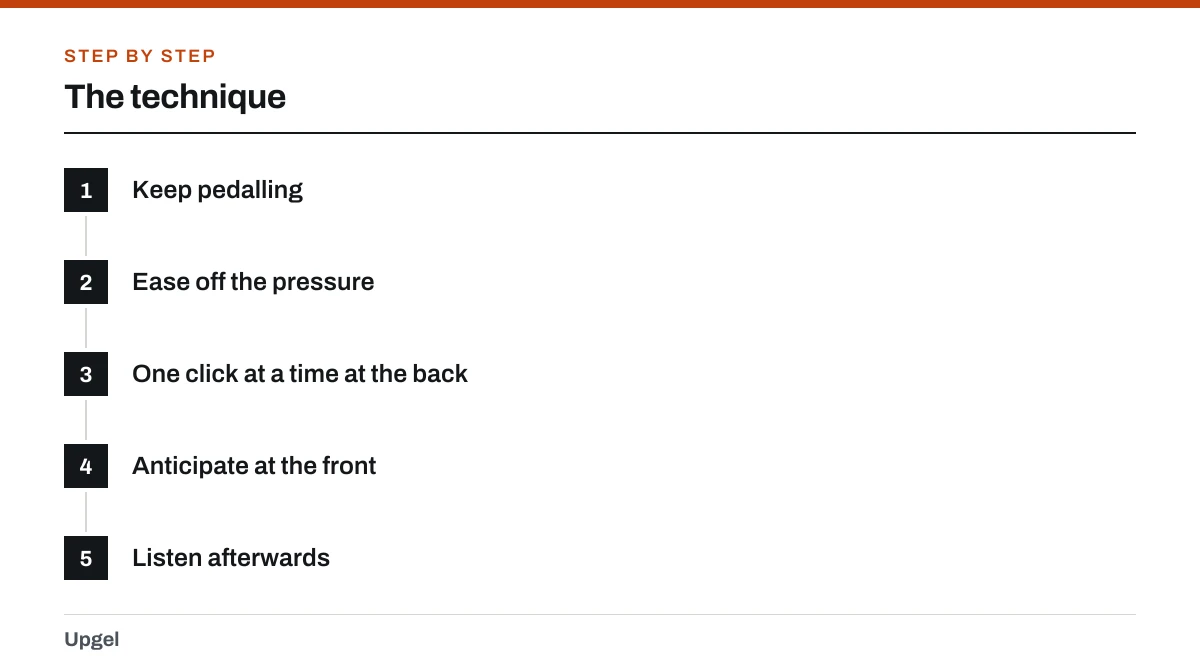
The technique
Keep pedalling
A derailleur moves the chain sideways while the chain is running. If you stop pedalling, nothing happens — and then the shift lands all at once when you start again, which is how chains get thrown off.
Ease off the pressure
As you click, soften your pedal stroke for half a revolution. Not stop — just stop pushing hard. This is the single biggest difference between a clean shift and a crunch.
One click at a time at the back
Let each shift complete before asking for the next. Modern shifters can dump several at once and it works, but it is harder on the chain.
Anticipate at the front
Front shifts are slower and clumsier than rear ones. Make them early, on flat ground or gentle gradient, never mid-effort on a steep pitch.
Listen afterwards
The drivetrain should go quiet once the shift completes. Persistent rattling means the gears want indexing — see adjusting bike gears.
Cross-chaining, and why it matters
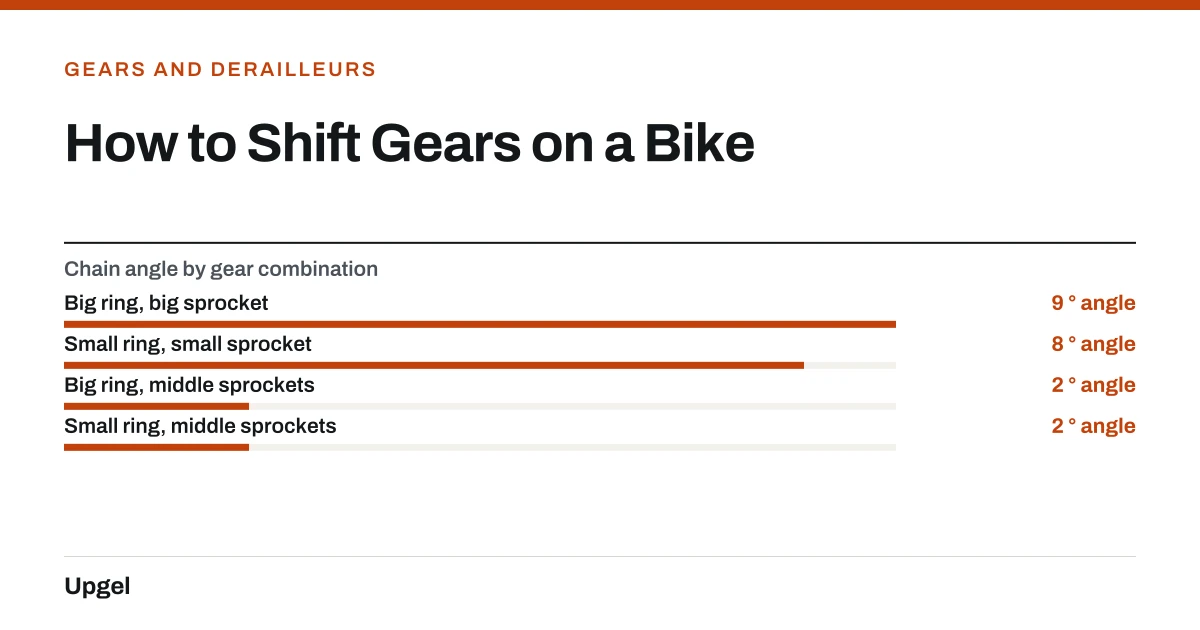
Cross-chaining means running the chain at a severe sideways angle — the largest chainring with the largest rear sprocket, or the smallest with the smallest. The chain still turns, but it is being flexed laterally on every link, every revolution.
- Big ring, big sprocket9° angle
Worst case. Noise, wear, poor shifting.
- Small ring, small sprocket8° angle
The other extreme. Also slack chain.
- Big ring, middle sprockets2° angle
Ideal for speed and flat ground.
- Small ring, middle sprockets2° angle
Ideal for climbing.
- It is noisy, and the noise is the chain rubbing the front derailleur cage — normal in those combinations, not a fault to adjust out.
- It wears the chain, the sprockets and the chainrings faster than any other riding you do.
- It shifts badly, because the derailleur is already at the end of its travel.
- The fix is not mechanical. Use the other chainring and pick a middle sprocket to get a similar gear at a far better chain line.
- Many shifters have a trim position — a half-click on the front that nudges the cage without changing ring — specifically to quieten this.
Different shifter types
| Type | Found on | How it works |
|---|---|---|
| Integrated brake/shift levers | Road and gravel bikes | The brake lever moves sideways, plus a smaller paddle behind it |
| Trigger shifters | Mountain and hybrid bikes | Two paddles under the bar, thumb and forefinger |
| Grip shift | Hybrids and older mountain bikes | Twist the grip itself |
| Bar-end and downtube | Older road bikes, touring | Levers at the bar ends or on the frame |
| Electronic | Higher-end modern bikes | Buttons; the derailleur is driven by a motor |
When shifting will not behave
If shifts are slow, noisy, or land in the wrong gear no matter how good your technique is, the problem is the setup rather than you. Start with adjusting bike gears, which works through the four possible causes in order. If it is specifically the front that misbehaves or drops the chain, go to adjusting a front derailleur; for the rear, adjusting a rear derailleur.
And if the chain skips under load in several gears, no amount of adjustment will help — that is wear, and it is covered in replacing a bike chain.
Frequently asked questions
Which gear should I use going uphill?
An easy one: the smaller chainring at the front and a larger sprocket at the back. Shift into it before the gradient starts, while you can still pedal lightly.
Should I stop pedalling when changing gear?
No. A derailleur can only move the chain while the chain is running. Keep pedalling but ease off the pressure for half a revolution as the shift happens.
What is cross-chaining and does it matter?
Running the biggest chainring with the biggest sprocket, or the smallest with the smallest. It puts the chain at a severe angle, which is noisy and wears the drivetrain faster. Use the other chainring and a middle sprocket instead.
Why do my gears click or rattle constantly?
Usually cable tension has drifted slightly, so the chain sits between two sprockets. A quarter turn of the barrel adjuster normally fixes it. Persistent rattle only in extreme gear combinations is cross-chaining and is normal.
Sources
- Derailer Adjustment — Sheldon Brown
Supports: Derailleur operation requiring chain movement, and why front shifts under load fail.
- Chains — Sheldon Brown
Supports: That cross-chained gear combinations increase chain and sprocket wear through lateral deflection.
- A novel model for bicycle drivetrain efficiency — Sports Engineering · DOI 10.1007/s12283-025-00505-8
Supports: That drivetrain configuration and chain line affect measured transmission efficiency.