How to Clean Bike Brake Rotors
By Cal WhitmoreUpdated 6 min read
The short answer
Wipe both sides with isopropyl alcohol on a lint-free cloth until it comes away clean. Never use degreaser or anything oil-based. If the pads are contaminated too, cleaning the rotor will not stop the squeal.
Key takeaways
- Isopropyl alcohol, nothing else. It evaporates completely and leaves no residue.
- The rotor is the easy half. Contaminated pads are porous and usually cannot be cleaned properly.
- Find the source — chain lube overspray, a hydraulic leak or degreaser drift — or you will be doing this again next week.
- Handle rotors by the spider arms. Fingerprints on the braking track are contamination.
A contaminated rotor announces itself immediately: a loud howl under light braking, noticeably less stopping power, and sometimes a grabby, on-off feel. It is one of the few bike problems where the symptom is dramatic and the fix is genuinely a two-minute job — provided the contamination has not soaked into the pads.
What contaminates a rotor
| Source | How it happens | Pads likely ruined? |
|---|---|---|
| Chain lube overspray | Aerosol lube drifting onto the rotor | Often |
| Degreaser drift | Cleaning the drivetrain near the caliper | Sometimes |
| Hydraulic fluid leak | Failed seal or damaged hose | Almost always |
| Fork oil | Leaking fork seal on a suspension bike | Almost always |
| Fingerprints | Handling the braking surface | Rarely — usually rotor only |
| Road spray and grit | Normal riding in the wet | No — just clean the rotor |
Cleaning the rotor
The two-minute clean
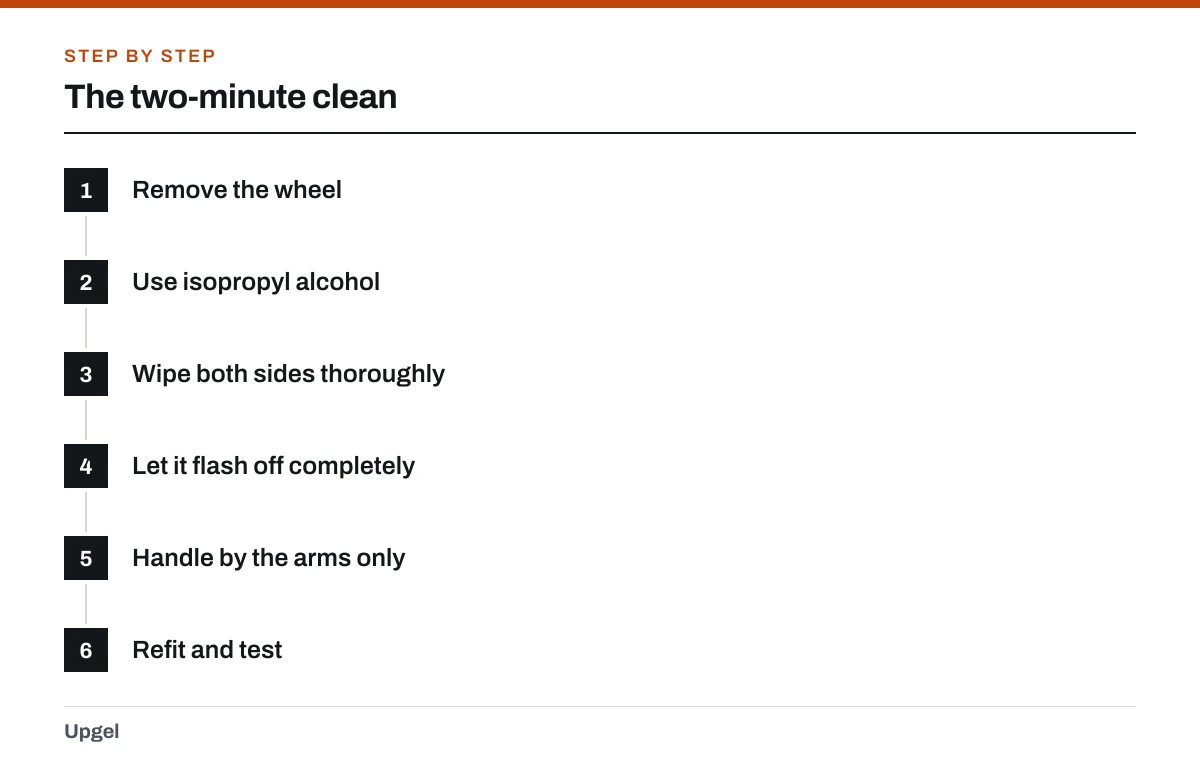
Remove the wheel
Not strictly necessary but it makes the job far easier and stops you contaminating the pads further. Method in removing a front bike wheel.
Use isopropyl alcohol
70% or higher, on a clean lint-free cloth or a paper towel. Do not reuse a rag that has been near chain lube.
Wipe both sides thoroughly
Work around the whole braking track. Use a fresh section of cloth each pass until it comes away without any grey or brown residue.
Let it flash off completely
Isopropyl evaporates in seconds. Do not refit the wheel while it is still wet.
Handle by the arms only
Pick the wheel up by the tire or the rotor's spider arms, never by the braking track.
Refit and test
Bed the brake back in with ten to fifteen firm stops at low speed.
Dealing with contaminated pads
Brake pad friction material is porous, which is exactly why it grips well and exactly why it absorbs oil. Once oil is in the pad, wiping the surface does very little — braking heat draws more oil out and the squeal returns within a few stops.
- Lightly glazed or dusty pads: sand the surface flat with fine emery paper on a hard, flat block, then bed them in again.
- Pads with a small amount of surface contamination: some people burn it off with a blowtorch until the pad glows briefly. It sometimes works and it can also destroy the pad.
- Pads soaked in hydraulic fluid or fork oil: replace them. There is no reliable recovery.
- Always replace pads in pairs, and both pads in a caliper together.
- Fitting instructions are in replacing bike brake pads.
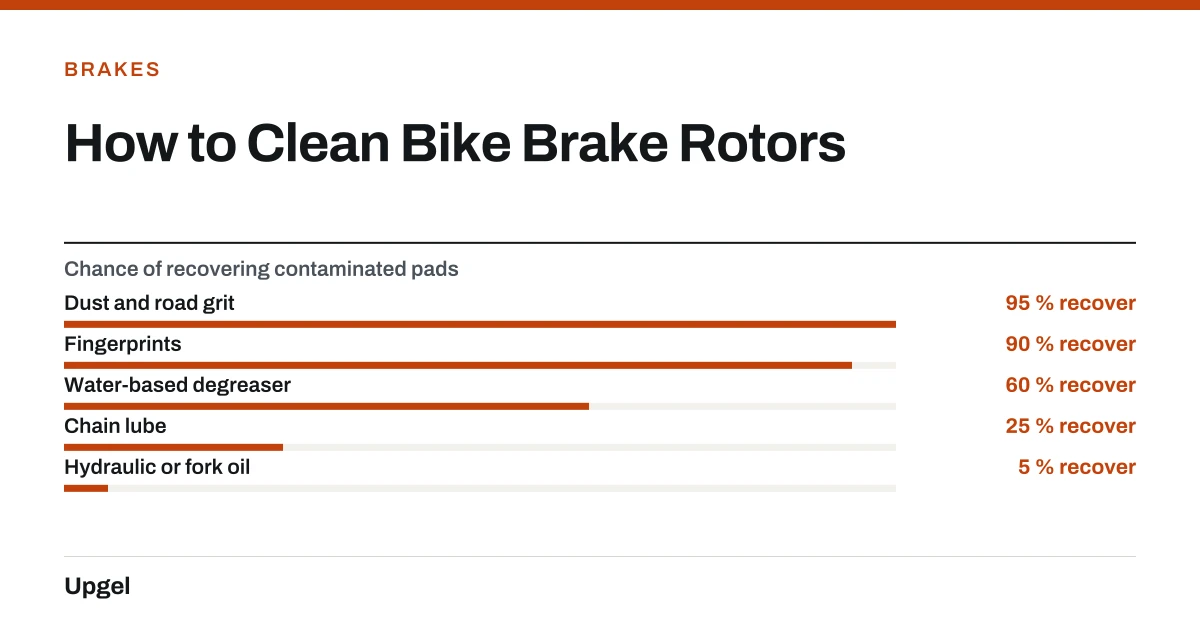
- Dust and road grit95% recover
Sand lightly, bed in, done.
- Fingerprints90% recover
Usually only the rotor needs cleaning.
- Water-based degreaser60% recover
Depends how long it soaked.
- Chain lube25% recover
Usually cheaper to replace the pads.
- Hydraulic or fork oil5% recover
Replace. And fix the leak first.
Preventing it
- Apply chain lube with the bike positioned so overspray cannot reach the rotor, and wipe the excess off immediately.
- Use drip lube rather than aerosol if you have disc brakes. It is far easier to control.
- Cover the rotor with a plastic bag or an old sock when degreasing the drivetrain.
- Remove the wheels before washing the bike if you are using anything stronger than soapy water — see cleaning a bike.
- Keep a dedicated rotor cloth that never touches lube or degreaser.
If cleaning does not resolve it, work through the fuller symptom list in fixing bike brakes, and check the caliper is properly centred using adjusting disc brakes.
Frequently asked questions
What should I use to clean bike brake rotors?
Isopropyl alcohol at 70% or higher on a clean lint-free cloth, or a brake cleaner specifically rated for bicycle discs. Nothing oil-based and no general degreaser.
Can I use WD-40 on brake rotors?
No. WD-40 is an oil-based water displacer and will severely reduce braking power, usually contaminating the pads as well as the rotor.
Why do my disc brakes still squeal after cleaning the rotor?
Because the contamination has soaked into the porous pad material. Cleaning the rotor alone will not fix it — sand the pads or, more reliably, replace them.
Can contaminated brake pads be saved?
Sometimes. Light surface contamination sands off with fine emery paper. Pads soaked in hydraulic fluid or fork oil should be replaced, as heat keeps drawing the oil back to the surface.
Sources
- Bicycle Brakes — Sheldon Brown
Supports: That any oil on the friction surface drastically reduces braking power and that pad material is porous.
- Tandem Brakes — Sheldon Brown
Supports: How braking heat draws absorbed contaminants back to the pad surface during sustained use.
- 16 CFR Part 1512 — Requirements for Bicycles — eCFR, US Government
Supports: Federal brake performance requirements that a contaminated braking system would fail.