How to Fix Bike Brakes: Symptom Guide
By Cal WhitmoreUpdated 8 min read
The short answer
Work from the symptom rather than guesswork. Squealing is usually pad angle or contamination, rubbing is caliper centring, weak braking is worn pads, and a sticking lever is nearly always a dry cable.
Key takeaways
- Diagnose before adjusting. Most brake problems are not solved by more cable tension, and tightening a contaminated brake makes it worse.
- Contamination is the single most under-diagnosed brake fault. Any oil on a rim or rotor destroys braking power.
- Rub that is constant means alignment. Rub once per wheel revolution means the rim or rotor is bent.
- A brake that works but feels vague is usually the cable and housing, not the caliper.
Most brake troubleshooting goes wrong in the same way: something feels off, so the barrel adjuster gets wound out, and now the brake is tight but still wrong. Brakes have a small number of failure modes and each one announces itself fairly clearly. Work from the symptom and you will usually land on the cause first time.
The symptom table
| Symptom | Most likely cause | Fix |
|---|---|---|
| High-pitched squeal | Pads parallel instead of toed in (rim), or contamination (disc) | Toe in the pads, or clean and replace |
| Constant light rub | Caliper off-centre | Centre the caliper |
| Rub once per wheel turn | Buckled rim or bent rotor | True the wheel or straighten the rotor |
| Weak braking, lever firm | Glazed or contaminated pads | Deglaze or replace; clean the surface |
| Lever pulls to the bar | Worn pads, stretched cable, or air in hydraulics | New pads, retension, or bleed |
| Lever stays in, brake drags | Dry, kinked or corroded cable and housing | Replace cable and housing |
| Grinding, metal on metal | Pads worn through to the backing | Stop riding; replace pads and inspect the surface |
| Judder under braking | Warped rotor, loose caliper bolts, or worn headset | Check each in that order |
Squealing
Squeal is vibration. The pad grabs, releases, and grabs again hundreds of times a second, and the frequency lands somewhere unpleasant. On rim brakes, the classic cure is toe-in: setting the leading edge of the pad about a millimetre closer to the rim than the trailing edge, so the pad progressively engages rather than slapping flat.
- Rim brakes: set toe-in, and clean both rim and pads. Grit embedded in a pad squeals and scores the rim.
- Disc brakes: squeal is usually contamination. Clean the rotor with isopropyl alcohol and replace the pads if oil has soaked in.
- New pads squeal until bedded in. Do twenty firm stops from moderate speed before judging them.
- Wet weather squeal on discs is normal and disappears after a few stops.
- Full pad setup detail is in adjusting bike brakes; rotor cleaning is in cleaning brake rotors.
Weak braking
If the lever feels firm and solid but the bike does not slow down properly, the problem is at the friction surface, not in the cable. Something is preventing the pad from gripping.
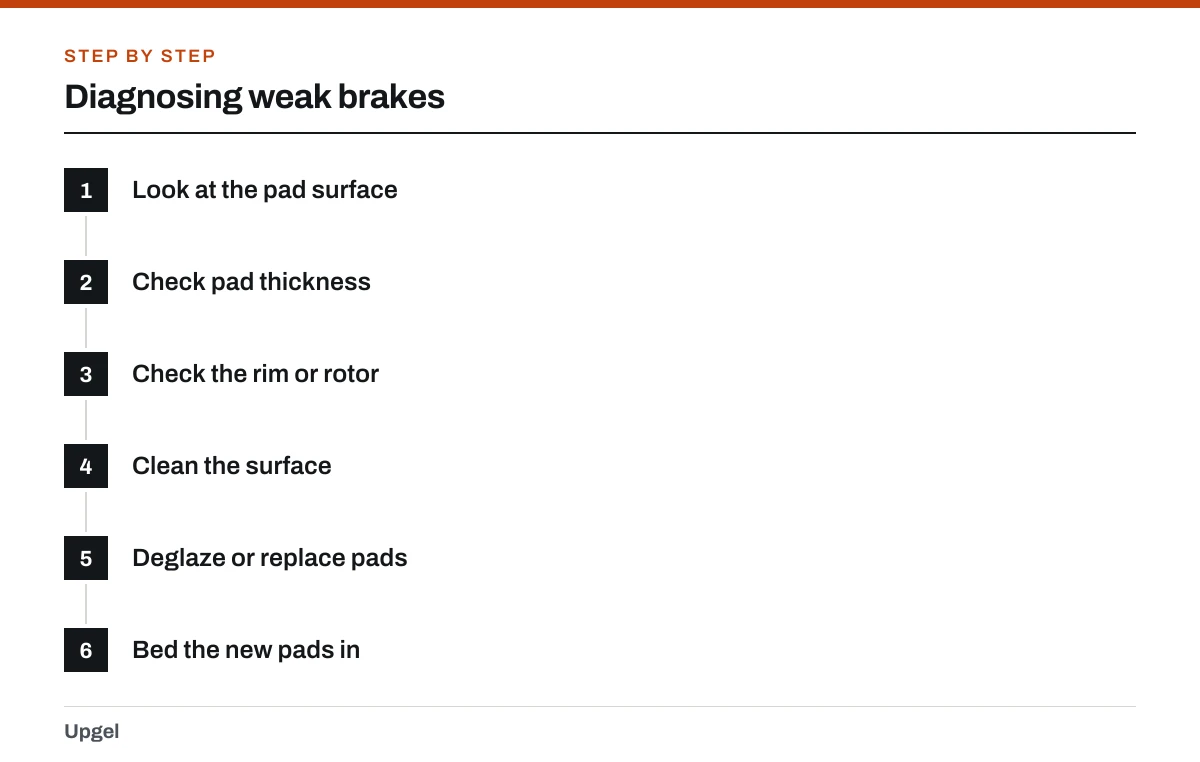
Diagnosing weak brakes
Look at the pad surface
A glazed pad looks shiny and glassy rather than matt. Contaminated pads often look dark and oily.
Check pad thickness
If the wear grooves are gone or the material is under about 1 mm on a disc pad, it is finished.
Check the rim or rotor
Run a clean finger along it. If it comes away with any residue, that residue is your problem.
Clean the surface
Isopropyl alcohol on a disc rotor. Rim brake surfaces can take a stronger degreaser, but rinse thoroughly.
Deglaze or replace pads
Light glazing sands off with fine emery paper. Oil-soaked pads cannot be saved — replace them.
Bed the new pads in
Twenty firm stops from moderate speed transfers an even layer of pad material to the surface.
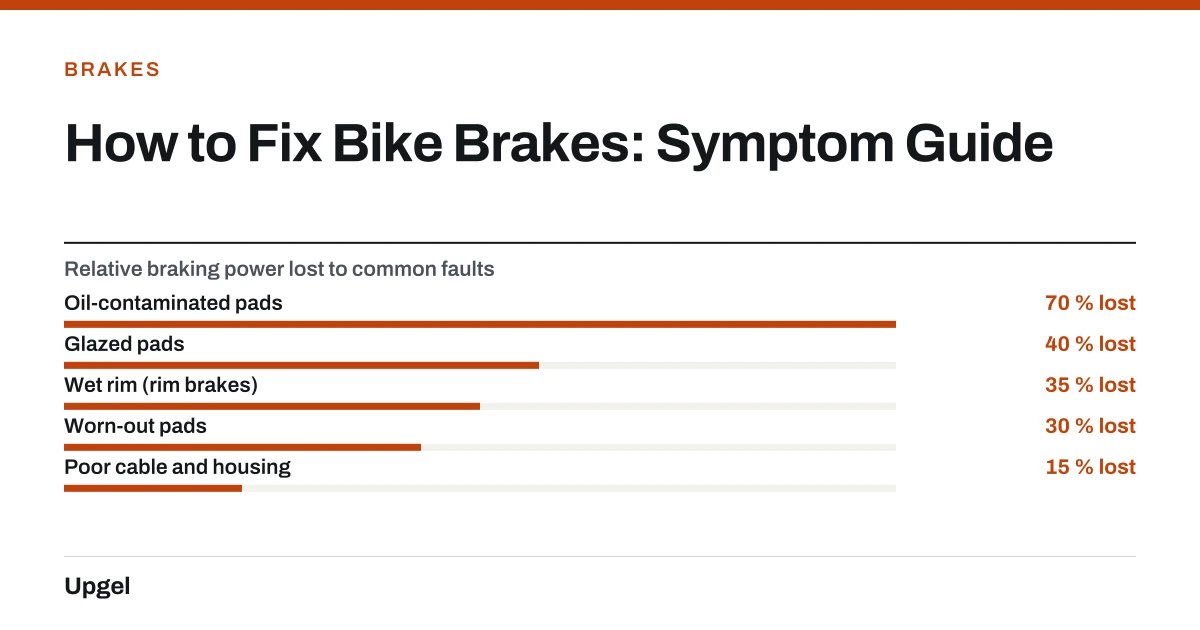
- Oil-contaminated pads70% lost
By far the worst. No adjustment recovers it.
- Glazed pads40% lost
Sandable if caught early.
- Wet rim (rim brakes)35% lost
Recovers after a few rotations of braking.
- Worn-out pads30% lost
And rapidly worsening.
- Poor cable and housing15% lost
Feels vague more than weak.
Sticking and dragging
If the lever does not spring back cleanly, or the brake stays partly on after you release it, the cable is not returning freely. Cables corrode inside the housing, especially where water sits at the bottom of a loop, and housing kinks trap the inner wire.
- Unhook the cable at the caliper and pull it through by hand. It should slide with almost no resistance.
- Look for kinks, splits or crushed sections in the outer housing, especially near the bars.
- Rust-coloured dust at the housing ends means the inner wire is corroding. Replace it.
- Check the caliper return spring and pivots. A dry pivot binds; a drop of light oil on the pivot, not the pads, usually frees it.
- Replacement is covered in replacing a bike brake cable.
The order to work in
- Look at the pads. Thickness, glazing, contamination. Most problems end here.
- Look at the braking surface. Rim wear, rotor damage, any residue.
- Check alignment. Centring, and whether rub is constant or once per revolution.
- Check the cable and housing. Free movement, no kinks, no corrosion.
- Only then adjust tension, using tightening bike brakes or loosening bike brakes.
Toeing in the brake shoes is the classic cure for brake squeal.
Sheldon Brown, Bicycle Brakes
Frequently asked questions
Why are my bike brakes squeaking?
On rim brakes, usually because the pads sit perfectly flat against the rim instead of slightly toed in. On disc brakes, squeal almost always means the rotor or pads are contaminated.
Why are my brakes rubbing?
If the rub is constant, the caliper is off-centre. If it comes and goes once per wheel revolution, the rim is buckled or the rotor is bent.
Why do my brakes feel weak even though they are tight?
The pads are almost certainly glazed, worn or contaminated. Tension controls when the pad arrives; it cannot make a contaminated pad grip.
Can I fix contaminated brake pads?
Lightly glazed pads can be sanded flat with fine emery paper. Pads that have absorbed oil cannot be reliably saved and should be replaced.
Sources
- Bicycle Brakes — Sheldon Brown
Supports: Toe-in as the standard cure for rim brake squeal, and rim wear limits at the braking surface.
- Tandem Brakes — Sheldon Brown
Supports: Heat and contamination effects on braking power, and why cable friction produces a vague lever.
- 16 CFR Part 1512 — Requirements for Bicycles — eCFR, US Government
Supports: That brake systems are subject to federal loading and performance tests under 1512.18.