How to Loosen Bike Brakes That Drag
By Cal WhitmoreUpdated 6 min read
The short answer
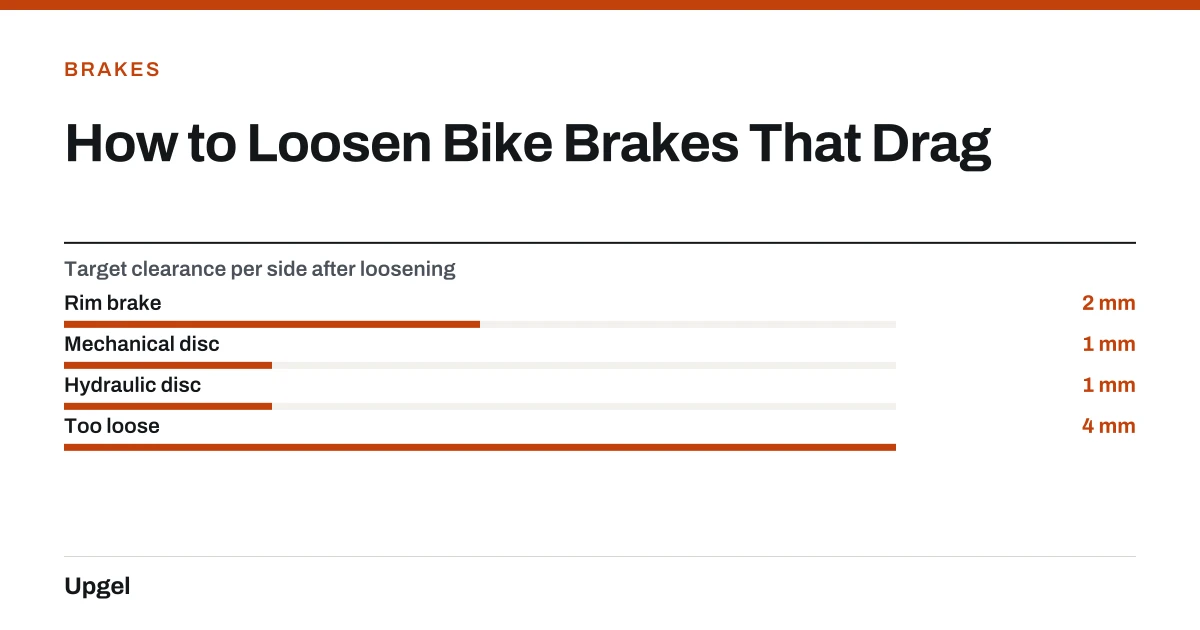
Turn the barrel adjuster clockwise: screwing it in shortens the housing path and opens the pad gap. Aim for 1 to 2 mm of clearance per side on rim brakes and about 1 mm on discs. If one pad drags, centre the caliper.
Key takeaways
- Clockwise on the barrel adjuster loosens; counter-clockwise tightens. It is the opposite of what most people guess.
- A dragging brake wastes energy, cooks the rim or rotor, and wears the pad away rapidly. It is worth fixing immediately.
- If only one side rubs, do not loosen the brake — centre the caliper. Loosening just moves the problem.
- Never loosen a brake far enough that the lever can reach the handlebar. That is not a fix, it is a hazard.
Brakes that are too tight are less obviously dangerous than brakes that are too loose, so they tend to get tolerated. They should not be. A pad that touches the rim continuously turns your effort into heat, wears the pad down in a fraction of its normal life, and on a long descent can heat a rim enough to matter.
First, work out what kind of tight
There is a real difference between a brake that is evenly too close and a brake that is off-centre. Spin the wheel and watch both pads.
| What you see | Cause | Fix |
|---|---|---|
| Both pads close, even gaps | Cable tension too high | Loosen with the barrel adjuster |
| One pad touching, other has a big gap | Caliper off-centre | Centre the caliper — do not loosen |
| Rub appears once per wheel revolution | Buckled rim or bent rotor | True the wheel or straighten the rotor |
| Brake stays on after releasing the lever | Sticky cable or seized pivot | Free or replace the cable; oil the pivots |
| Rub only after braking hard | Sticking piston (disc) | Clean and exercise the pistons |
Loosening with the barrel adjuster
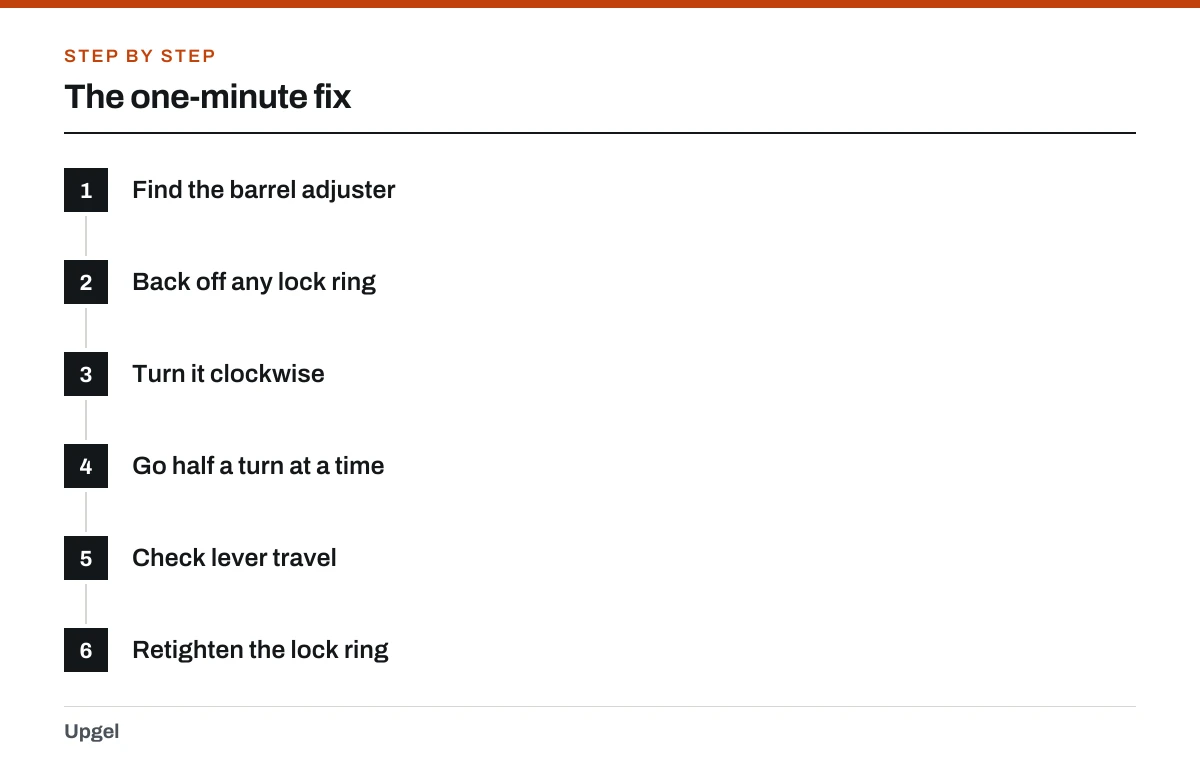
The one-minute fix
Find the barrel adjuster
Where the cable enters the brake lever on flat-bar bikes, or on the caliper on most road bikes.
Back off any lock ring
A thin knurled nut sits behind many adjusters and must be loosened before the adjuster will turn.
Turn it clockwise
Screwing it in shortens the effective housing length, which lets the cable relax and the pads open.
Go half a turn at a time
Spin the wheel between turns and listen. Stop as soon as the rub disappears.
Check lever travel
The brake should still bite about a third of the way through the lever stroke and must never reach the bar.
Retighten the lock ring
Against the adjuster, so vibration cannot shift it.
- Rim brake2mm
Enough to clear minor rim variation.
- Mechanical disc1mm
Discs run far closer than rim brakes.
- Hydraulic disc1mm
Set by the pistons, not by you.
- Too loose4mm
Lever travel becomes excessive and unsafe.
Centring instead of loosening
Centring is the correct fix for most brakes that rub on one side. How you do it depends on the brake.
- Side-pull caliper: a small grub screw on the caliper body shifts the whole assembly. Quarter turns.
- V-brake: a small spring tension screw at the base of each arm. Tighten the screw on the side the pads are pulled towards.
- Cantilever: same principle, spring tension screws on each arm.
- Disc caliper: loosen the two mounting bolts, squeeze and hold the lever, retighten. Details in adjusting disc brakes.
- If the caliper will not stay centred, the pivot is probably dry or the return spring is weak.
Why brakes go tight on their own
- Someone adjusted them and overshot. The most common cause by far.
- New cables bed in and the housing settles, which can occasionally tighten rather than loosen a setup.
- New pads are thicker than the worn ones they replaced, so the same cable tension gives a smaller gap.
- A wheel has been refitted slightly off-centre in the dropouts, so the rim sits closer to one pad.
- Cold weather stiffened the cable and housing, so the brake returns less completely.
If you have gone too far the other way and the lever now feels vague, tightening bike brakes covers taking the slack back up, and fixing bike brakes handles anything that is not simply a tension problem.
Frequently asked questions
Which way do I turn the barrel adjuster to loosen a brake?
Clockwise, screwing it into the lever or caliper. That shortens the housing path and opens the gap between pad and rim or rotor.
Why is only one of my brake pads rubbing?
The caliper is off-centre. Use the centring screw on a caliper brake, the spring tension screws on a V-brake, or the loosen-squeeze-retighten method on a disc caliper.
Is it bad to ride with brakes that rub?
Yes. Constant rub wastes noticeable energy, wears the pad away far faster than normal, and heats the rim or rotor, which is a real concern on long descents.
How much gap should there be between brake pad and rim?
About 1 to 2 mm per side on rim brakes, and roughly 1 mm on disc brakes. The lever should still bite around a third of the way through its travel.
Sources
- Bicycle Brakes — Sheldon Brown
Supports: Barrel adjuster direction, caliper centring methods for side-pull, V-brake and cantilever designs.
- Tandem Brakes — Sheldon Brown
Supports: Heat build-up from continuous braking contact and its effect on rims during sustained descents.
- 16 CFR Part 1512 — Requirements for Bicycles — eCFR, US Government
Supports: Federal brake performance requirements, which a brake loosened until the lever bottoms would not meet.