How to True a Bike Wheel at Home
By Cal WhitmoreUpdated 8 min read
The short answer
Spin the wheel, find where the rim moves sideways, then tighten the spokes pulling to the opposite side and loosen those pulling towards the wobble. Work a quarter turn at a time across three or four spokes.
Key takeaways
- Spokes pull, they never push. To move the rim left, you tighten left-side spokes or loosen right-side ones.
- Quarter turns, spread over several spokes. A half turn on one nipple creates a new problem next to the old one.
- Turning direction is confusing because you work from above the rim — the nipple is upside down relative to you.
- If a spoke is loose enough to rattle, or one is broken, truing is the wrong fix. Tension or replace first.
A wheel is a surprisingly clever structure: a thin rim held in a stable circle by fifty-odd wires, each pulling inwards. Nothing pushes. Once you internalise that, truing stops being mysterious — you are simply adjusting which wires pull hardest, and the rim moves towards the tighter side.
You do not need a truing stand. The brake pads on a rim-brake bike make an excellent gauge, and on a disc bike you can cable-tie a marker to the frame. What you do need is a correctly sized spoke wrench and the patience to make small changes.
What you need
- A spoke wrench that actually fits your nipples. Common sizes are 3.2, 3.3 and 3.45 mm; a loose wrench rounds the nipple off and then you have a real problem.
- A gauge: your brake pads, a zip-tie taped to the chainstay, or a truing stand if you have one.
- Something to mark the rim — a chalk stick or a marker pen.
- Optional: a spoke tension meter, useful but not essential for correcting a small wobble.
Find the wobble
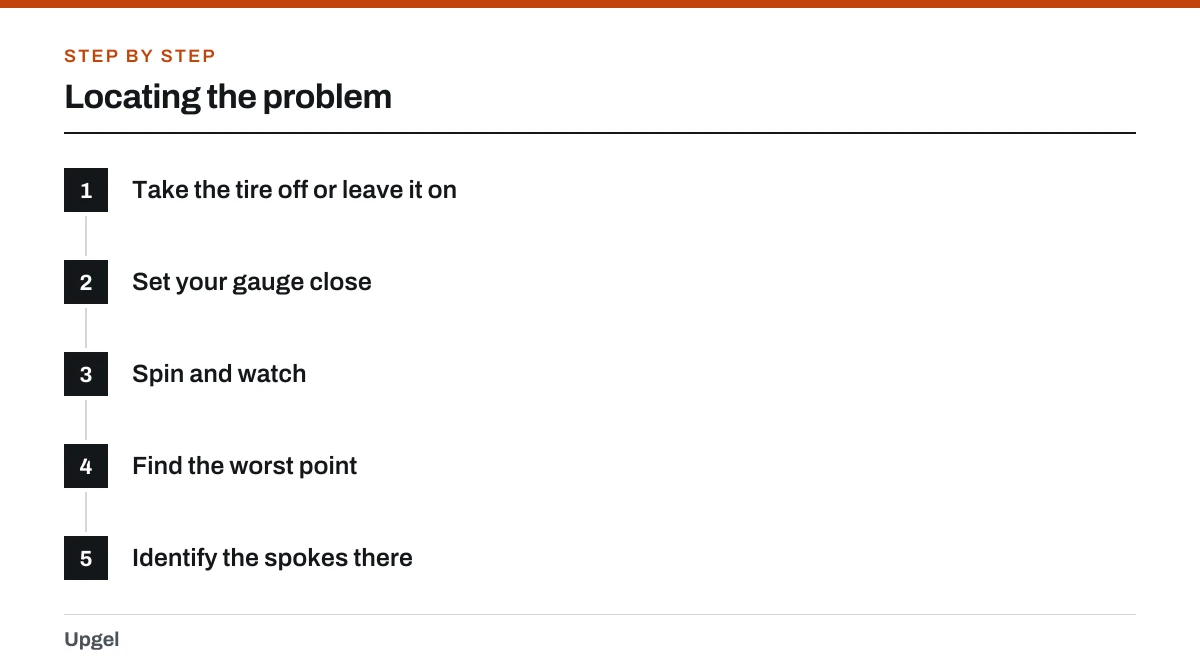
Locating the problem
Take the tire off or leave it on
Either works for lateral truing. Removing it lets you see the rim clearly; the process is in removing and installing a bike tire.
Set your gauge close
Wind the brake pads in, or position a zip-tie, so it nearly touches the rim at its closest point.
Spin and watch
Watch where the rim moves towards the gauge. Mark the start and end of that section with chalk on the rim.
Find the worst point
Narrow the gauge and re-spin until only the very worst spot touches. That is your centre of correction.
Identify the spokes there
Look at which side of the hub the spokes at that point go to. They alternate left, right, left, right.
Which way to turn
This is where people get lost. Spoke nipples have a normal right-hand thread, but you are working on them from above the rim, looking down at what is effectively the head of an upside-down bolt. From that viewpoint, turning the wrench clockwise tightens the spoke.
| Rim pulls to | Tighten | Loosen |
|---|---|---|
| Right (drive side) | Left-side spokes at that point | Right-side spokes at that point |
| Left (non-drive side) | Right-side spokes at that point | Left-side spokes at that point |
The truing process
Correcting a lateral wobble
Start at the worst point
Give the spoke at the centre of the bend a quarter turn in the correcting direction.
Feather outwards
Give the next spokes on either side an eighth of a turn each. This spreads the correction over an inch or two of rim instead of creating a sharp kink.
Spin and re-check
Do not do several sections before checking. Re-spin, see what changed, and re-mark.
Repeat, reducing the increment
As it gets closer, drop to eighth turns. The last stage of truing is very small adjustments.
Stop at good enough
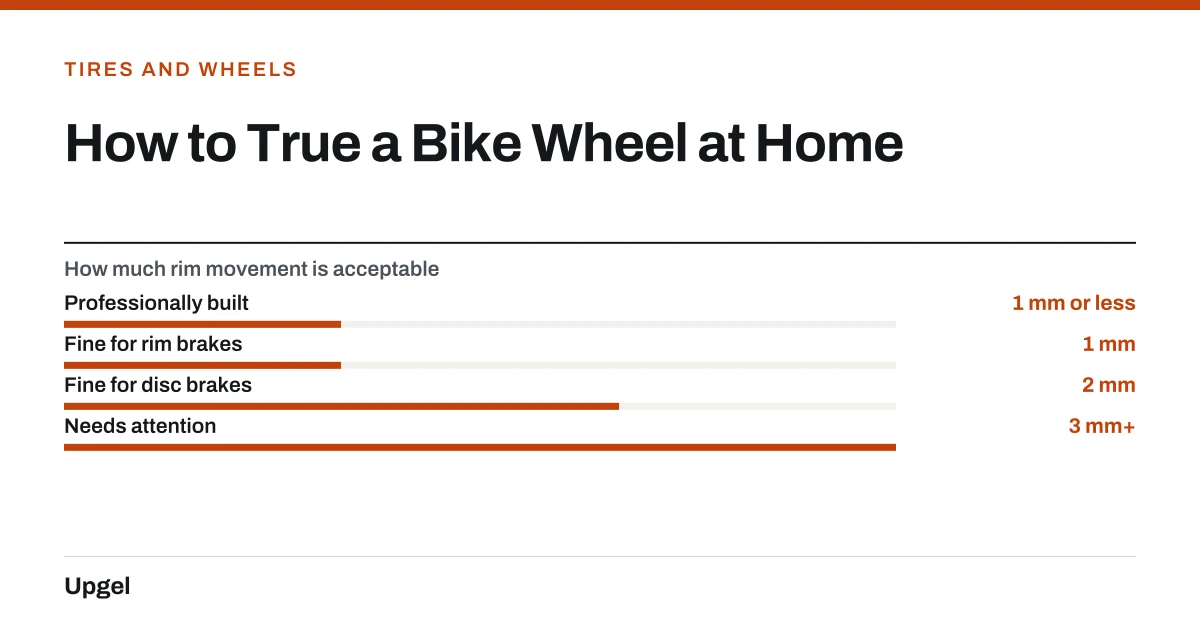
Under about a millimetre of lateral movement is fine for riding. Chasing perfection on a used rim is usually futile — the rim itself has dents.
Stress-relieve the wheel
Squeeze pairs of spokes firmly all the way round, then re-check. This settles the spokes into the hub and rim, and it is why a wheel that seemed true can drift after one ride.
- Professionally built1mm or less
What a good wheelbuilder delivers.
- Fine for rim brakes1mm
Beyond this you get pad rub as the wheel turns.
- Fine for disc brakes2mm
Braking is at the hub, so the rim has more latitude.
- Needs attention3mm+
Check for loose or broken spokes rather than truing harder.
When truing is not the answer
- A dented or flat-spotted rim. You can hide some of it with spoke tension, but the rim is bent and will never run properly true.
- Several broken spokes, or a wheel where tension is wildly uneven. That is a rebuild, not a true.
- A cracked rim, especially around a spoke hole. Replace it; a crack there fails suddenly.
- A wheel that goes out of true every few rides. Something is wrong with tension or the rim, and repeatedly truing it just masks the cause.
Once the wheel runs true, refit the tire, reset your brakes — our guide to adjusting bike brakes covers pad clearance — and check that nothing rubs through a full rotation. Wheel trueness and spoke tension are both worth checking periodically rather than only when something starts rubbing, which is what the routine in tuning up a bike is for.
Tightening a spoke pulls the rim toward the side of the hub that spoke is attached to.
Sheldon Brown, Wheelbuilding
Frequently asked questions
Can I true a bike wheel without a truing stand?
Yes. Use the brake pads as a gauge on a rim-brake bike, or cable-tie a marker to the frame on a disc bike. The stand is faster and more precise, not essential.
Which way do I turn a spoke nipple to tighten it?
Clockwise as you look down at it from outside the rim. It feels backwards because you are viewing the nipple from what is effectively the underside of the thread.
How much should I turn each spoke?
A quarter turn at the worst point, an eighth on the spokes either side, then re-check. Larger adjustments create a new kink next to the one you fixed.
Why does my wheel keep going out of true?
Usually uneven or insufficient spoke tension, a spoke that has come loose, or a rim that is dented. Repeatedly truing without addressing tension treats the symptom.
Sources
- Wheelbuilding — Sheldon Brown
Supports: That spokes only pull, the direction the rim moves when a spoke is tightened, and stress-relieving after adjustment.
- Tires and Tubes — Sheldon Brown
Supports: Removing and refitting the tire to inspect the rim during truing.
- Bicycle Tools — Sheldon Brown / Harris Cyclery
Supports: Spoke wrench sizing and why an ill-fitting wrench rounds off nipples.