How to Change a Bike Inner Tube
By Cal WhitmoreUpdated 7 min read
The short answer
Deflate fully, lever one bead off the rim and pull the old tube out. Put a couple of strokes of air into the new tube so it holds its shape, seat the valve squarely, then roll the bead back on with your thumbs.
Key takeaways
- Buy tubes by the ETRTO number on your tire sidewall. A 25-622 tire takes a tube marked roughly 23–28 x 622.
- Presta valves are narrow with a lock nut; Schrader are wide like a car valve. The rim hole decides which you can use.
- A slightly inflated tube almost never gets pinched. A flat one very often does.
- The last six inches of bead go on by hand. Reaching for a lever there is the most common way to puncture a brand-new tube.
Changing an inner tube is the same job as changing a tire, minus the tire. You leave the casing on the rim, swap what is inside it, and put everything back. It is a job that rewards patience at exactly two moments: choosing the right tube, and getting the last stretch of bead on without trapping it.
Getting the size right
Tube sizing confuses people because tires carry two sets of numbers. The marketing size looks like 700x25c or 26x1.95. The ETRTO size looks like 25-622 or 50-559, and it is the one that cannot be misread. The first number is width in millimetres, the second is the bead seat diameter of the rim.
| Tire marking | ETRTO | Tube to buy |
|---|---|---|
| 700x25c road | 25-622 | 700c, 23–28 mm range |
| 700x38c hybrid | 38-622 | 700c, 35–43 mm range |
| 650b / 27.5 gravel | 47-584 | 27.5 in, 1.75–2.1 in range |
| 26x1.95 MTB | 50-559 | 26 in, 1.75–2.125 in range |
| 29x2.25 MTB | 57-622 | 29 in, 2.0–2.4 in range |
Presta or Schrader?
Schrader valves are the wide ones, identical to a car tire valve. Presta valves are narrow, have a small knurled nut you unscrew before inflating, and are standard on road bikes. The rim decides: a Schrader valve will not fit through a Presta-sized hole, and a Presta valve in a Schrader hole will wobble and eventually tear at the base unless you use a grommet or adapter.
- Unscrew the Presta lock nut before inflating, and press it briefly to break the seal if the tube is brand new.
- Do not overtighten the knurled rim nut. Finger tight is enough; it exists to stop the valve disappearing into the rim while you attach the pump.
- Schrader valves take a car pump, which makes them convenient for commuters and kids' bikes.
Fitting the new tube
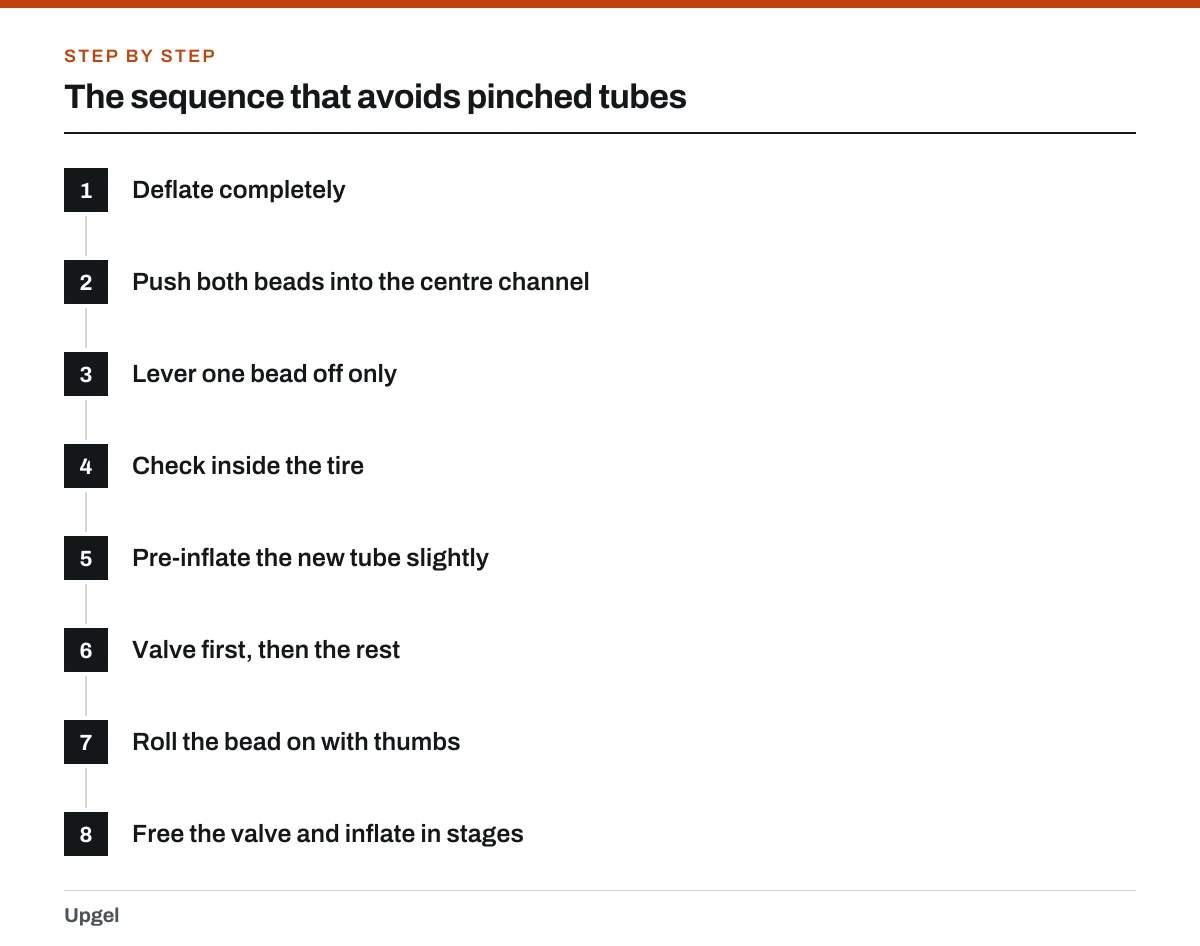
The sequence that avoids pinched tubes
Deflate completely
Any residual air keeps the bead locked against the rim wall and makes levering much harder.
Push both beads into the centre channel
The rim is deepest in the middle. That slack is what lets one side come off with two levers instead of a fight.
Lever one bead off only
Leave the other bead seated. You are not removing the tire, only opening it.
Check inside the tire
Run a finger all the way round. If something punctured the old tube it is probably still there — diagnosing the cause matters more than the repair.
Pre-inflate the new tube slightly
Two or three pump strokes. It should look round, not fat. This is the step that prevents pinching.
Valve first, then the rest
Push the valve straight through its hole so it is perpendicular to the rim, then tuck the tube up inside the tire all the way round.
Roll the bead on with thumbs
Work away from the valve in both directions, constantly pushing the fitted section into the centre channel to keep slack available.
Free the valve and inflate in stages
Push the valve up into the tire and pull it back down. Inflate to half, check the bead line, then full.
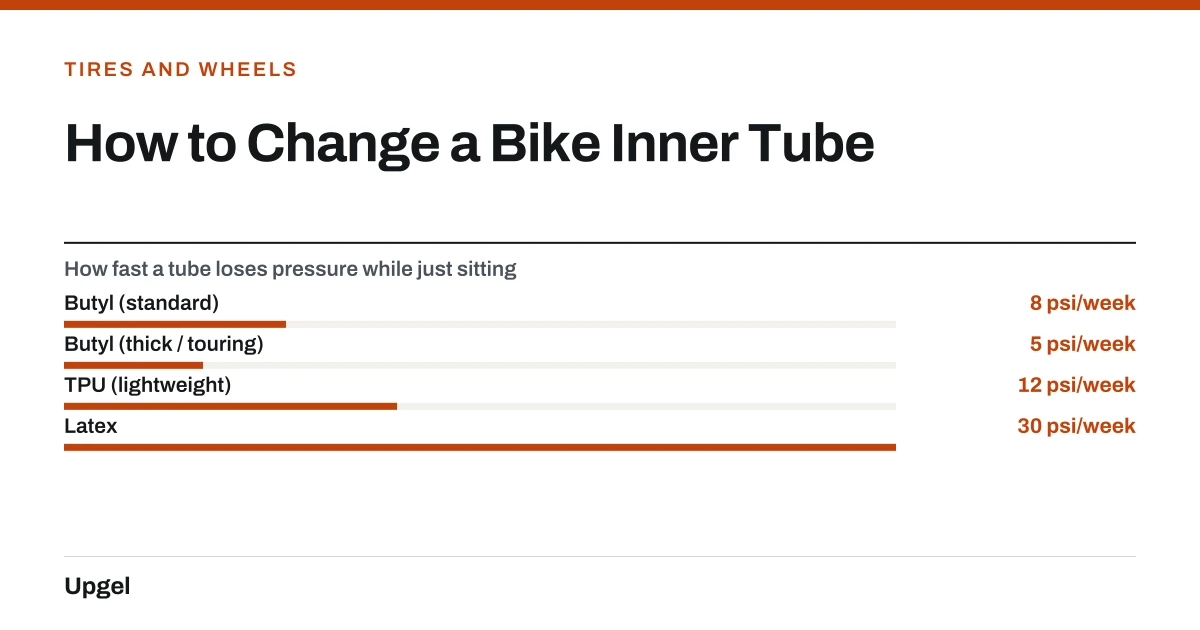
- Butyl (standard)8psi/week
The normal black tube. Top up weekly.
- Butyl (thick / touring)5psi/week
Heavier walls leak slightly less.
- TPU (lightweight)12psi/week
Very light and compact, but check before every ride.
- Latex30psi/week
Needs inflating before every single ride.
After the swap
Refit the wheel, reconnect the brake if you released it, and spin the wheel to check for rub. If the tire wobbles side to side as it spins, the bead has not seated evenly — deflate and reseat rather than living with it. If the wheel itself wobbles, that is a different problem and our guide on how to true a bike wheel covers it.
Keep the old tube unless the valve tore. A tube with a single clean hole is worth patching, and a patched tube is as reliable as a new one.
Frequently asked questions
What size inner tube do I need?
Read the ETRTO number on the tire sidewall, such as 25-622. Buy a tube whose diameter matches the second number and whose width range includes the first.
Can I use a 700c tube in a 29-inch tire?
Yes — both are 622 mm rims. Just make sure the tube's width range covers your tire width, since a narrow road tube stretched into a 2.3 inch MTB tire will be very thin-walled and prone to failure.
Why did my new inner tube go flat immediately?
Usually it was pinched under the bead during fitting, or the object that caused the original flat is still embedded in the tire. Both are avoidable by pre-inflating the tube and checking the casing.
Should the valve nut be tight?
Only finger tight. Its job is to hold the valve still while you attach a pump. Overtightening puts stress on the valve base and can tear it when the tube shifts under load.
Sources
- Tire Sizing Systems — Sheldon Brown
Supports: ETRTO numbering, the 700c/29-inch 622 mm equivalence, and matching tube width ranges to tire width.
- Tires and Tubes — Sheldon Brown
Supports: Valve types, the function of the knurled rim nut, and relative air retention of butyl versus latex tubes.
- Flat Tire Prevention and Repair — Sheldon Brown
Supports: Checking the casing for embedded debris before fitting a replacement tube.