How to Fix a Flat Bike Tire (and Why)
By Cal WhitmoreUpdated 8 min read
The short answer
Take the wheel off and remove the tube, then find what caused the puncture before fitting the replacement — check inside the tire and the rim tape. Fit a fresh tube, seat the bead evenly and inflate.
Key takeaways
- Finding the cause matters more than the repair. Fit a new tube over the same thorn and you will be stopped again within a mile.
- Two holes side by side means a pinch flat from low pressure, not a puncture. The fix is more air, not a better tire.
- A hole on the rim side of the tube points at rim tape or a spoke end, not the road.
- Carry a spare tube and patch the punctured one at home. Patching at the roadside in the cold is miserable and the glue needs time to cure.
A flat is the most common thing that will ever go wrong with your bike, and it is also the most misunderstood. Most people focus entirely on getting air back in. The part that actually determines whether you get home is the two minutes you spend working out why the tube failed in the first place.
This guide covers the repair itself and, more importantly, the diagnosis. If you already know the cause and just need the mechanical sequence, our full walkthrough on how to change a bike tire covers wheel removal and bead seating in more depth.
First: read the flat
Before you throw the old tube away, pump a little air into it and listen. Hold it near your ear and rotate it slowly, or pass it through a puddle if you cannot hear anything. Where the hole is tells you what happened, and that determines what you need to fix.
| What you find | Cause | What to do about it |
|---|---|---|
| One clean hole on the tread side | Sharp object came through the tire | Find and remove the object. Check the tire for a cut that needs booting. |
| Two holes side by side, ~5 mm apart | Pinch flat — the tube was crushed between rim and an edge | Run higher pressure. The tire and rim are usually undamaged. |
| Hole on the rim side of the tube | Rim tape slipped, or a spoke end is protruding | Replace or reposition the rim tape. File down a proud spoke. |
| Tear around the valve base | Valve was fitted at an angle, or ridden flat | Fit the valve square next time. This tube is not repairable. |
| A long clean slit | Blowout, often from a badly seated bead | Check bead seating carefully on the rebuild. |
The repair, step by step
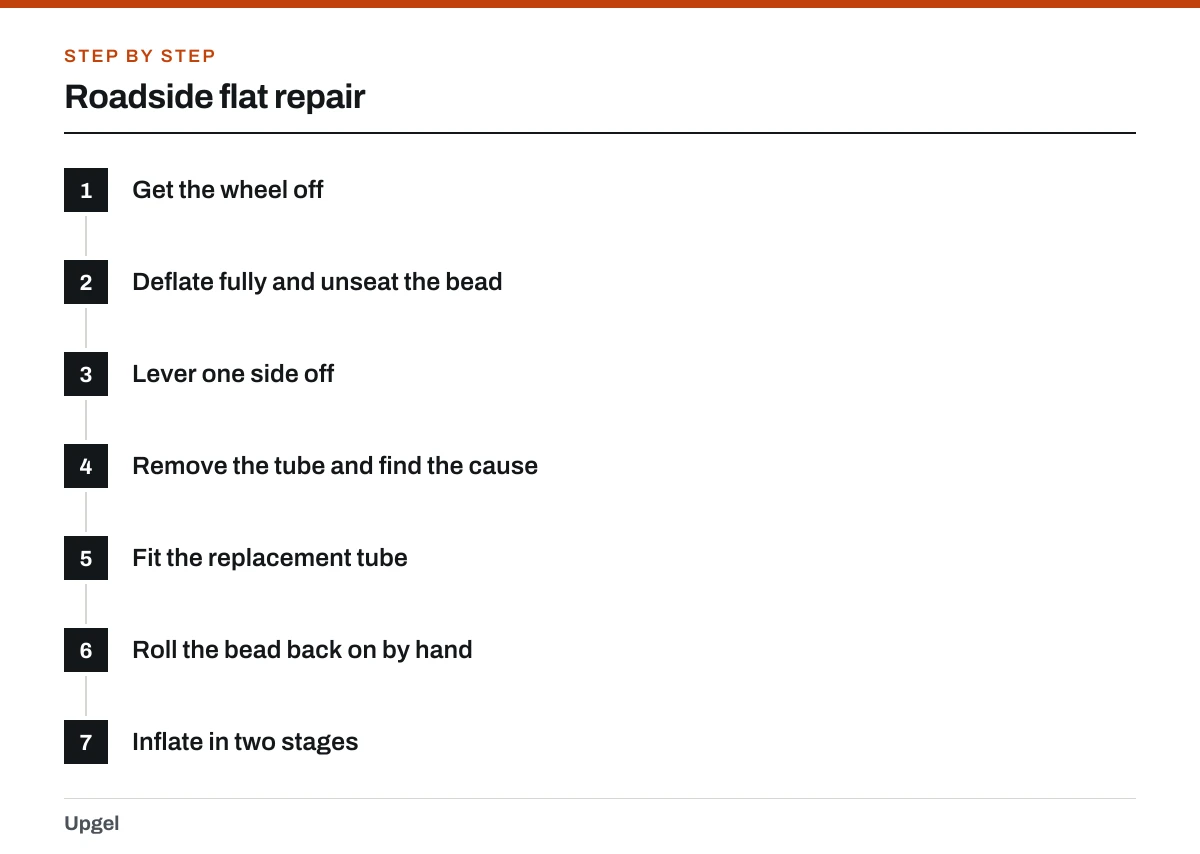
Roadside flat repair
Get the wheel off
Shift to the smallest sprocket if it is the rear wheel, release the brake if it is a rim brake, then open the quick-release or thru-axle.
Deflate fully and unseat the bead
Push both sides of the tire into the deep centre channel of the rim. This creates the slack that makes levering easy.
Lever one side off
Two levers, starting opposite the valve. Leave the other bead on the rim — you do not need to remove the tire completely.
Remove the tube and find the cause
Note where the tube sat relative to the tire so you can match the hole to a spot on the casing. Then check that spot.
Fit the replacement tube
Put two or three strokes of air in it first, seat the valve square, and tuck the tube inside the tire all the way round.
Roll the bead back on by hand
Thumbs, not levers. Finish at the valve, then push the valve up and pull it down to free any trapped tube.
Inflate in two stages
Half pressure, check the bead line is even all the way round on both sides, then go to full pressure.
When the tire itself is cut
If the object left a cut you can see daylight through, a new tube will bulge out of it and fail almost immediately. You need a boot: something stiff placed inside the tire, between the casing and the tube, spanning the cut. A folded banknote works. So does an energy-bar wrapper or a section cut from an old tire. A purpose-made tire boot is better but you will rarely have one.
A boot is a get-home fix, not a repair. Replace the tire when you get back — our guide on how long bike tires last explains which damage is terminal and which is cosmetic.
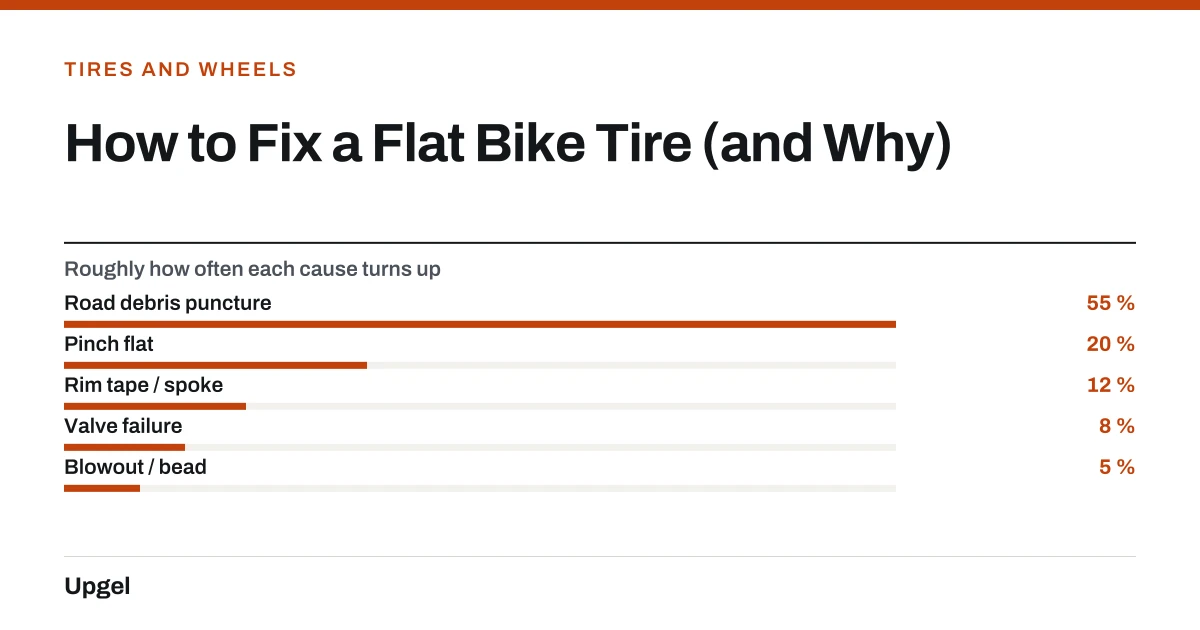
- Road debris puncture55%
Glass, flint, thorns, wire. By far the most common.
- Pinch flat20%
Almost always underinflation. Check pressure weekly.
- Rim tape / spoke12%
Look here when the hole faces the rim.
- Valve failure8%
Often from riding on a soft tire.
- Blowout / bead5%
Usually a fitting error on the previous change.
Stopping it happening again
- Check pressure weekly. Tubes lose air on their own — a butyl tube can drop 5–10 psi a week even when perfectly healthy.
- Run pressure appropriate to your weight and tire width. Most pinch flats are underinflation, not bad luck.
- Replace rim tape when you replace a tire. It is cheap and it perishes.
- Consider puncture-resistant tires for commuting. They are heavier and slower, and worth it if you ride the same glassy road every day.
- Do not ride on a flat, even a short distance. It wrecks the tube, often the tire, and sometimes the rim.
Most flats are caused by under-inflation.
Sheldon Brown, Flat Tire Prevention and Repair
Fixing a flat is genuinely a ten-minute job once you stop treating it as an emergency. The skill worth building is the diagnostic habit: never fit a new tube without knowing what killed the old one.
Frequently asked questions
Can I patch a bike tube instead of replacing it?
Yes, and a properly applied patch is permanent. Patch at home where you can prep the surface and let the glue cure for five minutes, and carry a spare tube for the roadside.
Why does my bike tire keep going flat?
Almost always because the cause is still in the tire, the rim tape has slipped, or you are running too little pressure. Check all three before blaming the tubes.
How do I find a slow puncture?
Inflate the tube hard and pass it through water, or hold it against your cheek while rotating it — you will feel the airflow before you hear it. A slow leak can take a minute to find.
Is it safe to ride home on a flat tire?
No. Riding on a flat destroys the tube, usually damages the tire sidewall, and can dent an alloy rim. Walk, or fit a boot and inflate enough to roll gently.
Sources
- Flat Tire Prevention and Repair — Sheldon Brown
Supports: Pinch-flat identification from paired holes, the role of under-inflation, and rim-tape failures causing rim-side punctures.
- Tires and Tubes — Sheldon Brown
Supports: Bead seating checks and tube sizing when fitting a replacement.
- Tire Sizing Systems — Sheldon Brown
Supports: Matching a replacement tube and tire to the rim's bead seat diameter.