How Long Do Bike Tires Last?
By Cal WhitmoreUpdated 7 min read
The short answer
Most bike tires last 1,000 to 3,000 miles, but condition beats mileage. Replace one when the tread has gone flat and square, casing threads show through, a cut reaches the casing, or the sidewall is cracked.
Key takeaways
- Rear tires wear roughly twice as fast as front tires, because most of your weight and all of your drive torque sit on them.
- A flat, square profile down the centre strip is the clearest wear signal on any tire that started out round.
- Age matters independently of mileage. Rubber hardens and sidewalls crack after roughly five to six years even unused.
- A bulge in the sidewall is not a wear item — it is a failing casing. Replace it before the next ride, not at the next service.
"How long do bike tires last" has an unsatisfying answer: it depends enormously on the tire. A featherweight racing tire and a wire-bead commuting tire are both round and black and can differ by a factor of five in lifespan. What is useful is knowing the ranges, and knowing what to look at so you are judging your actual tire rather than a number.
Realistic mileage by tire type
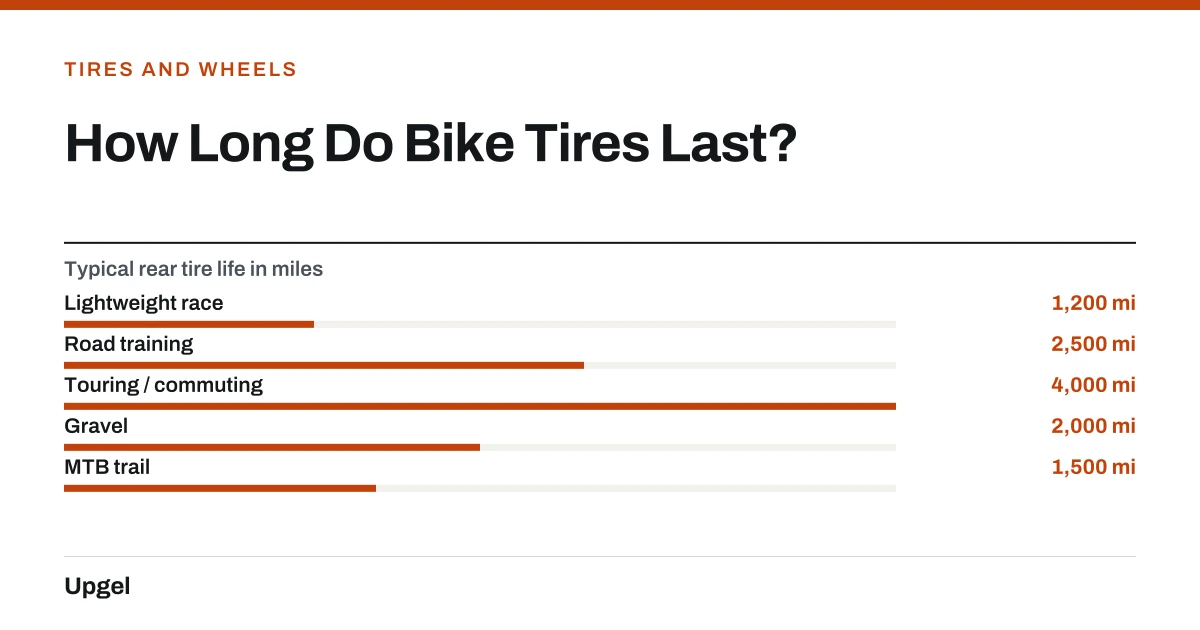
These are working ranges rather than manufacturer claims. Where you ride matters as much as what you ride on: chip-seal and city grit chew tires far faster than smooth tarmac.
- Lightweight race1,200mi
Soft, fast compounds. Grip is the priority, not longevity.
- Road training2,500mi
The everyday road tire. Harder compound, more rubber.
- Touring / commuting4,000mi
Thick tread and a puncture belt. Built for miles.
- Gravel2,000mi
Wears on tarmac, tears on rock. Highly route-dependent.
- MTB trail1,500mi
Knob tearing usually ends these before the casing does.
The four signs it needs replacing
| What you see | What it means | How urgent |
|---|---|---|
| Flat, square centre strip | Tread worn down; the round profile is gone | Replace soon — grip and handling are degrading |
| Wear indicator holes gone | Manufacturer's own depth marker reached | Replace soon |
| Casing threads visible | Tread is completely worn through | Replace now — a blowout is likely |
| Cuts you can see the casing through | Structural damage; tube will bulge into it | Replace now; boot it to get home |
| Sidewall cracking or a bulge | Casing degraded or failing | Do not ride it |
Not every tire has wear indicators. Many road tires have two or three small dimples moulded into the centre of the tread; when they disappear, the tire is done. Mountain bike tires rarely have them, because knob height and tearing are the practical limit instead.
What makes tires wear faster
- Low pressure. An underinflated tire flexes more, runs hotter and abrades faster — and it invites pinch flats, covered in our guide to fixing a flat bike tire.
- Hard braking and skidding. A single locked-wheel skid can flat-spot a rear tire permanently.
- Rough surfaces. Chip-seal, gravel and city grit are abrasive in a way smooth tarmac is not.
- Rider and cargo weight. A loaded touring bike or cargo bike works its tires considerably harder.
- Heat and UV. Tires stored in direct sunlight or near a heat source age noticeably faster.
How to check yours
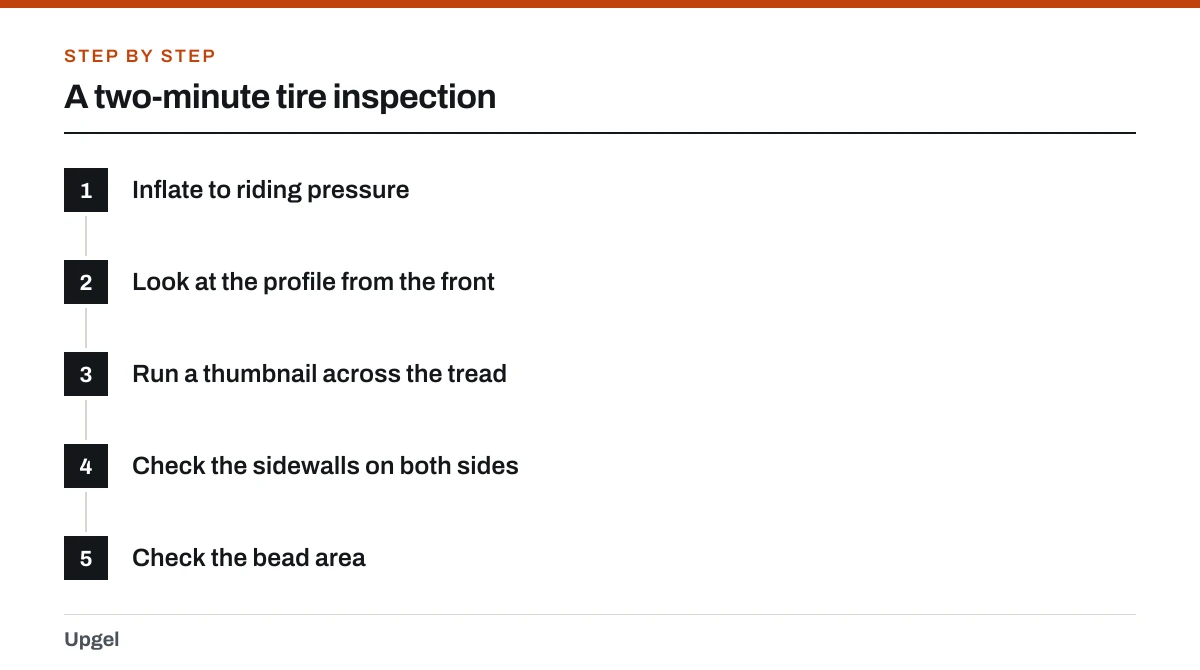
A two-minute tire inspection
Inflate to riding pressure
A soft tire hides both cuts and profile wear. Check at proper pressure.
Look at the profile from the front
Spin the wheel and sight along the tire. A new tire is round; a worn one has a visibly flat strip down the middle.
Run a thumbnail across the tread
You are feeling for cuts and embedded debris. Anything sharp comes out now, before it works through to the tube.
Check the sidewalls on both sides
Look for fine cracking, fraying threads, or any bulge. Flex the sidewall gently to reveal cracks.
Check the bead area
Where the tire meets the rim, look for chafing or exposed cords. This area fails quietly.
Replacing them
Fitting new tires is the same job as fixing a flat, minus the urgency. Our full walkthrough on how to change a bike tire covers wheel removal, bead seating and inflation, and the guide to removing and installing a bike tire deals with genuinely tight tire and rim combinations.
Replace the rim tape at the same time if it looks perished or has slipped, and fit a new tube rather than reusing an old one that has been sitting compressed under a worn tire. If the old tube has a single clean hole, patch it and keep it as your spare.
The ETRTO/ISO number is the only tire size designation that is unambiguous.
Sheldon Brown, Tire Sizing Systems
Frequently asked questions
How many miles do bike tires last?
Typically 1,000 to 3,000 miles for a rear tire, depending heavily on type. Lightweight race tires can be finished by 1,000 miles; touring tires can pass 4,000.
Should I replace both bike tires at once?
Not necessarily. Rear tires wear about twice as fast. A common approach is to move the part-worn front tire to the rear and fit the new tire on the front.
Do bike tires expire if unused?
Effectively, yes. Rubber hardens and sidewalls crack with age, and most tires are past their best after roughly five to six years even in storage.
Is a cracked sidewall dangerous?
Fine surface cracking is a sign the tire is aged and should be replaced soon. A bulge or a crack deep enough to show casing threads means the tire is unsafe to ride now.
Sources
- Tires and Tubes — Sheldon Brown
Supports: Tread wear profile, casing construction, and why worn or aged sidewalls fail.
- Tire Sizing Systems — Sheldon Brown
Supports: Reading the sidewall to buy a correctly sized replacement tire.
- Flat Tire Prevention and Repair — Sheldon Brown
Supports: The link between under-inflation, accelerated wear and pinch flats.