How to Adjust Disc Brakes on a Bike
By Cal WhitmoreUpdated 8 min read
The short answer
Loosen the two caliper bolts a quarter turn, squeeze and hold the lever so the caliper self-centres on the rotor, then retighten while still holding. On mechanical discs, set the fixed inboard pad first.
Key takeaways
- Rub is nearly always caliper alignment or a bent rotor, not pad wear.
- Hydraulic brakes have no cable adjustment at all — the pistons self-compensate as pads wear.
- Mechanical disc brakes have a fixed pad that must be set with its own dial before cable tension means anything.
- A rotor is 1.8 mm of steel. It bends easily and straightens easily with a proper truing fork.
Disc brakes are excellent right up until something rubs, and then they are maddening — a faint tick-tick-tick every wheel revolution that you cannot un-hear. The good news is that the fix is almost always one of three things, and all three take a couple of minutes once you know which one you are dealing with.
Mechanical or hydraulic?
Look at what runs into the caliper. A thin steel cable in a housing means mechanical. A sealed hose, usually with a banjo fitting, means hydraulic. This determines almost everything about what you can adjust.
| Mechanical disc | Hydraulic disc | |
|---|---|---|
| Caliper centring | Yes | Yes |
| Cable tension | Yes, barrel adjuster and anchor bolt | No cable exists |
| Fixed pad position | Yes, inboard dial | No, pistons self-adjust |
| Compensates for pad wear | No — you re-adjust manually | Yes, automatically |
| Fix for spongy lever | New cable and housing | Bleed the system |
Centring the caliper — fixes most rub
The lever-squeeze method
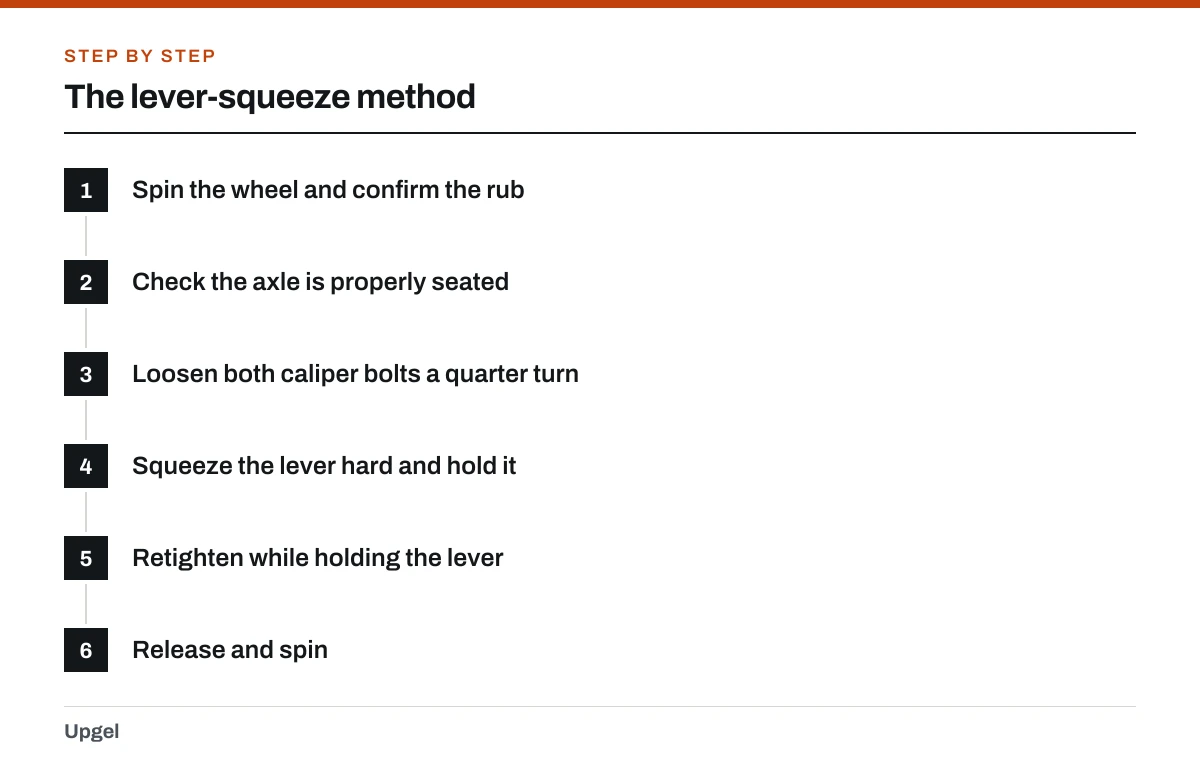
Spin the wheel and confirm the rub
Look through the caliper from behind. You will usually see which pad is touching, and whether it rubs all the way round or only at one point.
Check the axle is properly seated
A wheel sitting crooked in the dropouts will always rub. Re-seat it first — the method is in removing a front bike wheel.
Loosen both caliper bolts a quarter turn
The caliper should be able to slide sideways but not rattle around freely.
Squeeze the lever hard and hold it
Both pads clamp the rotor, which pulls the caliper into perfect alignment with it.
Retighten while holding the lever
Alternate between the two bolts, a little each, so the caliper does not twist as it clamps down. Around 6–8 Nm is typical.
Release and spin
If it still rubs faintly, repeat — it commonly takes two goes. If it rubs only at one point in the rotation, the rotor is bent, not the caliper misaligned.
Setting mechanical disc brakes
Most mechanical disc calipers move only one pad; the other is fixed and set by a dial or an Allen key adjuster on the inboard side. If you skip this, cable tension can never give you a good result — you are asking one pad to do all the travel.
Mechanical pad setup
Back the cable right off
Wind the barrel adjuster in and slacken the anchor bolt so the moving pad is fully retracted.
Wind the fixed pad in until it touches the rotor
Turn the inboard adjuster until you feel it contact, then back it off a click or two — roughly 0.5 mm of clearance.
Set the moving pad with cable tension
Pull the cable snug at the anchor bolt so the outboard pad also sits about 0.5 mm off the rotor.
Fine-tune at the barrel adjuster
Small changes only. Aim for a lever that bites about a third of the way through its travel.
Re-centre the caliper
Now do the lever-squeeze centring above, because moving the pads changes where the caliper wants to sit.
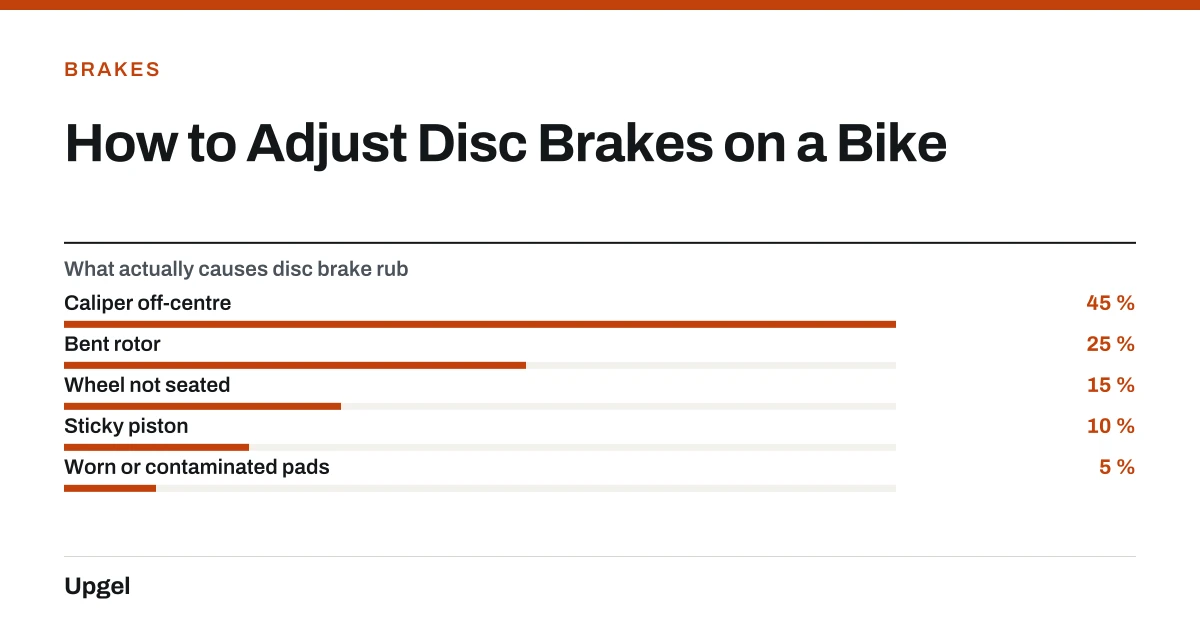
- Caliper off-centre45%
Fixed by the lever-squeeze method in two minutes.
- Bent rotor25%
Rub once per revolution. Straighten with a truing fork.
- Wheel not seated15%
Re-seat the axle before touching the caliper.
- Sticky piston10%
Clean and exercise the pistons.
- Worn or contaminated pads5%
Replace them.
Straightening a bent rotor
A rotor is a thin steel disc and it bends if the bike falls over, if it catches on something during transport, or occasionally from heat. Spin the wheel slowly and watch the rotor pass between the pads — you will see the wobble. Mark the high spot with a marker.
- Use a rotor truing fork if you have one. In a pinch, an adjustable wrench opened to just over 1.8 mm works.
- Bend gently and re-check constantly. Steel moves more than you expect and overcorrecting is easy.
- Never touch the braking surface with bare fingers — skin oil contaminates it. Handle by the spider arms.
- If the rotor is visibly warped over a wide area or worn below its minimum thickness, replace it. Minimum thickness is usually stamped on the rotor itself.
What hydraulic brakes need instead
There is no cable to tension, so the adjustment list is short: centre the caliper, keep the rotor straight, keep everything clean. If the lever feels spongy or pulls further than it used to despite good pads, air has got into the system and it needs bleeding — a job with brake-fluid-specific kit that many people reasonably hand to a shop.
For rim brakes the whole approach is different — pad height and toe-in matter far more. That is covered in adjusting bike brakes, and symptom-led diagnosis for either type is in fixing bike brakes.
Frequently asked questions
Why do my disc brakes rub after changing a wheel?
Usually the axle is not fully seated in the dropouts, or the caliper needs re-centring. Re-seat the wheel first, then use the lever-squeeze centring method.
How do I stop disc brake rub?
Loosen the two caliper bolts a quarter turn, squeeze and hold the brake lever so the caliper self-aligns, then retighten both bolts while still holding the lever.
Can you adjust hydraulic disc brakes?
Only the caliper position and, on some levers, the lever reach. Pad clearance is maintained automatically by the pistons, so there is no tension adjustment.
How do I know if my rotor is bent?
If the rub appears and disappears once per wheel revolution rather than being constant, the rotor is bent. Spin the wheel slowly and watch the rotor pass between the pads.
Sources
- Bicycle Brakes — Sheldon Brown
Supports: Mechanical brake cable tensioning principles and the distinction between fixed and moving pad designs.
- Tandem Brakes — Sheldon Brown
Supports: Heat handling in disc brake systems and why rotor thickness and condition affect performance.
- 16 CFR Part 1512 — Requirements for Bicycles — eCFR, US Government
Supports: Federal braking performance requirements that apply regardless of whether a bicycle uses rim or disc brakes.