How to Remove a Bike Crank
By Cal WhitmoreUpdated 8 min read
The short answer
Identify the crank type first. External-bearing cranks undo with an 8 mm Allen key and a preload cap. Square-taper and splined cranks need a crank puller threaded fully into the arm before you wind it in.
Key takeaways
- Identify the type before buying a tool. The wrong crank puller will strip the arm's extractor threads.
- Square taper and splined cranks cannot be pulled off by hand or by levering. They need a crank puller.
- Thread the puller in fully. Half-engaged threads tear out of an aluminium crank arm under load.
- Never hammer a crank off. It destroys the bottom bracket bearings even when the arm survives.
Crank removal is the one job in this hub where the tool genuinely matters, and where the right tool for one bike will damage another. So the first half of this guide is about working out what you have — that part is not optional.
Identify your crank
| Type | How to spot it | Tool needed |
|---|---|---|
| External bearing (Hollowtech II, GXP) | Large bearing cups outside the frame; plastic preload cap on the left arm; two pinch bolts | 8 mm Allen key + preload cap tool |
| Self-extracting | A retaining ring around the crank bolt | 8 mm Allen key only |
| Square taper | Bolt or nut in a recess; axle is a tapered square | Crank puller, square taper type |
| Splined (Octalink, ISIS) | Bolt in a recess; axle has splines, not a taper | Crank puller, splined type |
| Press-fit one-piece | Cranks and axle are a single unit | Often removes with the arm; varies by design |
Before you start
- Remove the pedals if the crank is coming right off the bike. Remember the left one is reverse-threaded — removing bike pedals covers it.
- Shift the chain onto the smallest chainring to get it out of the way.
- Clean the area around the crank bolt. Grit in the bolt recess makes the Allen key sit shallow and round the head.
- Photograph the assembly, including the order of any spacers and washers.
- Work on the left, non-drive side first on modern external-bearing cranksets. It is the side designed to come off.
Removing an external-bearing crank
This is what most bikes made in the last fifteen years use, and it is the easiest of the three. The left arm clamps onto a splined axle that is permanently attached to the right arm.
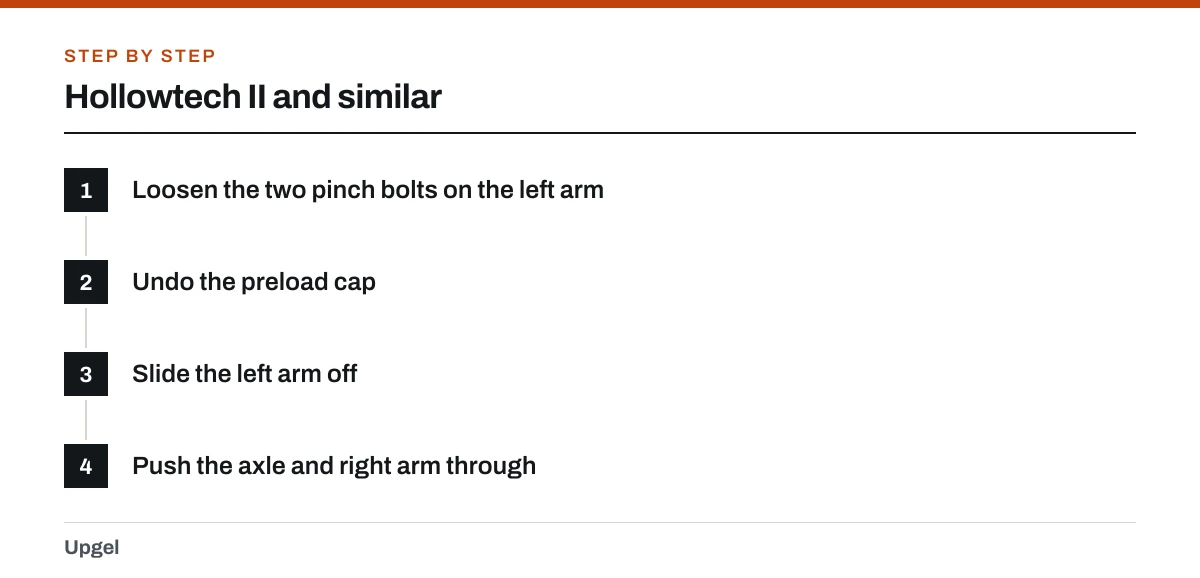
Hollowtech II and similar
Loosen the two pinch bolts on the left arm
Usually 5 mm Allen. Loosen both, alternating a little at a time, and take them out or leave them very loose.
Undo the preload cap
The plastic cap in the centre of the left arm. It takes a specific splined plastic tool, which is inexpensive and comes with most cranksets. It is only setting bearing preload, so it is barely tight.
Slide the left arm off
With both pinch bolts loose and the cap out, the arm pulls off the splines by hand. If it resists, check that the pinch bolts are fully loose and that the small retaining tab is lifted clear.
Push the axle and right arm through
From the left side, push the axle through the bottom bracket. A gentle tap with a soft mallet on the axle end — never on the crank arm — is fine if it is stiff.
Using a crank puller
Square taper and splined cranks are pressed onto the axle by the crank bolt and will not come off by hand. A crank puller is a two-part tool: an outer body that threads into the crank arm, and a centre bolt that pushes against the axle.
Square taper and splined removal
Remove the crank bolt or nut
Usually 8 mm Allen or 14 mm socket, inside a recess. Some have a dust cap over them that unscrews first.
Get the washer out
There is often a washer under the bolt. It must come out — if it stays in, the puller pushes against the washer instead of the axle and nothing happens except damage.
Back the puller's centre bolt right out
So only the outer body threads in, with the centre bolt clear of the way.
Thread the outer body fully into the crank arm
By hand first, then snug with a spanner. Fully is the critical word — every thread you can engage is one that will not tear out. This is the step that ruins cranks when rushed.
Tighten the centre bolt
As it advances it presses on the axle end and forces the arm off the taper. It gets progressively harder, then releases with a distinct pop.
Repeat on the other side
Same procedure. Keep track of which arm came from which side.
What not to do
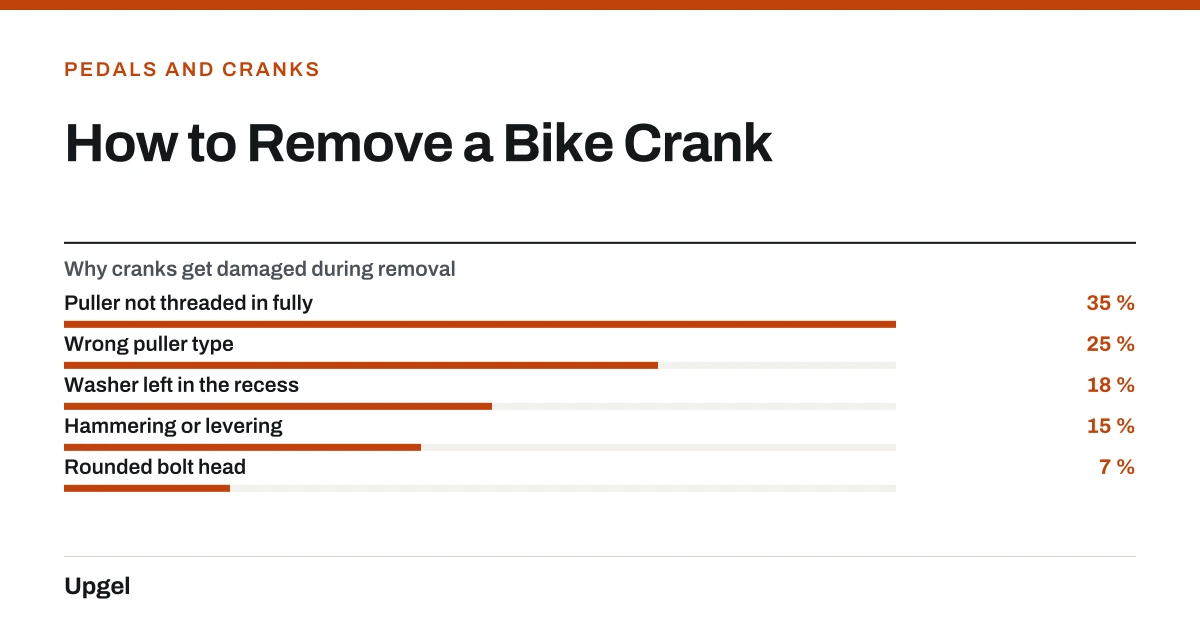
- Puller not threaded in fully35%
Threads tear out of the arm.
- Wrong puller type25%
Square taper tool on a splined axle.
- Washer left in the recess18%
Puller pushes on the washer, not the axle.
- Hammering or levering15%
Wrecks bottom bracket bearings.
- Rounded bolt head7%
Grit in the recess, or a worn Allen key.
- Do not hammer the crank arm. Even when the arm survives, the shock load goes straight through the bottom bracket bearings and ruins them.
- Do not lever between the crank arm and the frame. You will mark the frame and may crack the arm.
- Do not ride a bike with a loose crank bolt. A loose square taper arm will deform its own square hole within a few miles, and then it will never sit tight again.
- Do not substitute a bolt or a socket for a crank puller. The tool exists because the force required is genuinely high and needs to be applied squarely.
Refitting
- Clean the axle and the crank arm interface thoroughly. Any grit changes how far the arm seats.
- Whether to grease a square taper is genuinely debated — grease lets the arm seat further up the taper. Follow the crank manufacturer's guidance rather than a rule of thumb.
- Tighten the crank bolt to the manufacturer's torque, commonly around 40 Nm on square taper.
- On external-bearing cranks, set the preload cap only finger-tight — it sets bearing preload, not clamping force — then torque the pinch bolts alternately.
- Re-check the bolt torque after the first ride. Square taper arms in particular settle slightly as they seat, and crank play is one of the things worth testing for during a regular tune-up.
Frequently asked questions
Do I need a special tool to remove a bike crank?
For square taper and splined cranks, yes — a crank puller matched to the axle type. Modern external-bearing cranks usually need only an 8 mm Allen key and an inexpensive plastic preload cap tool.
Can I remove a bike crank without a crank puller?
Only a self-extracting or external-bearing crank. A square taper or splined arm is pressed onto the axle and cannot be pulled or levered off without damaging the arm, the axle or the bearings.
Why won't my crank come off with the puller?
Most often the washer was left in the bolt recess, so the puller is pushing against it rather than the axle. Otherwise the puller body is not threaded in far enough, or it is the wrong type for your axle.
Can I hammer a stuck crank off?
No. The shock passes straight through the bottom bracket bearings and destroys them, and it can crack the crank arm. Use the correct puller, fully threaded in.
Sources
- Cranks — Sheldon Brown
Supports: Crank types, square taper and splined interfaces, crank puller operation and extractor thread limitations.
- Bottom Bracket Sizing — Sheldon Brown
Supports: Bottom bracket and axle standards, and the fit between axle and crank.
- Bicycle Tools — Sheldon Brown / Harris Cyclery
Supports: That square taper and splined crank pullers differ in centre bolt diameter and are not interchangeable.