Why Are Bike Seats So Uncomfortable?
By Cal WhitmoreUpdated 8 min read
The short answer
Usually the saddle is the wrong width for your sit bones, the position is too low or tilted, or you are riding in ordinary underwear. A softer, wider saddle tends to make it worse, not better.
Key takeaways
- More padding is usually the wrong answer. Soft saddles let you sink until soft tissue carries the load.
- Width should match your sit bone spacing, which you can measure at home with cardboard.
- Numbness is a different problem from soreness and needs sorting promptly, not endured.
- Padded shorts with no underwear underneath do more for comfort than almost any saddle upgrade.
Bike saddles have a reputation for being instruments of torture, and the standard response — buy a wider, softer one — reliably makes things worse. Understanding why requires knowing what a saddle is actually for.
What a saddle is supposed to do
A saddle is not a chair. It is meant to support your weight on the two ischial tuberosities — the sit bones — which are the parts of your pelvis built to carry load. Everything between and in front of them is soft tissue, containing nerves and blood vessels that are not built to be sat on.
So a good saddle is one where your sit bones land on firm support. It follows that a very soft saddle is a bad one: your sit bones sink through the padding until the padding bottoms out, and by then the soft tissue between them is bearing weight too. That is why the wide, gel-topped saddle that seemed like the obvious purchase is often the least comfortable thing you can buy.
The real causes, in order
| Symptom | Most likely cause | First thing to try |
|---|---|---|
| Sore sit bones | Saddle too wide or too narrow; new rider | Measure sit bones; give it a few weeks |
| Pain at the front, soft tissue | Saddle too wide, or nose tilted up | Level the saddle; consider a cutout |
| Numbness or tingling | Pressure on the perineal nerves | Level or slightly nose-down; cutout saddle; stop and stand periodically |
| Chafing and rubbing | Seams, or riding in ordinary underwear | Padded shorts, no underwear, chamois cream |
| Sliding forward constantly | Nose tilted down | Level it |
| Sore only on one side | Leg length difference, or saddle not straight | Check saddle alignment first |
| Aching after long rides only | Normal adaptation, or position too low | Check saddle height |
Getting the width right
Sit bone spacing varies between roughly 100 and 150 mm, and it does not correlate reliably with body size — small riders can have wide sit bones and vice versa. A saddle needs to be wide enough that both sit bones land on the supportive part, without being so wide that the edges rub your thighs.
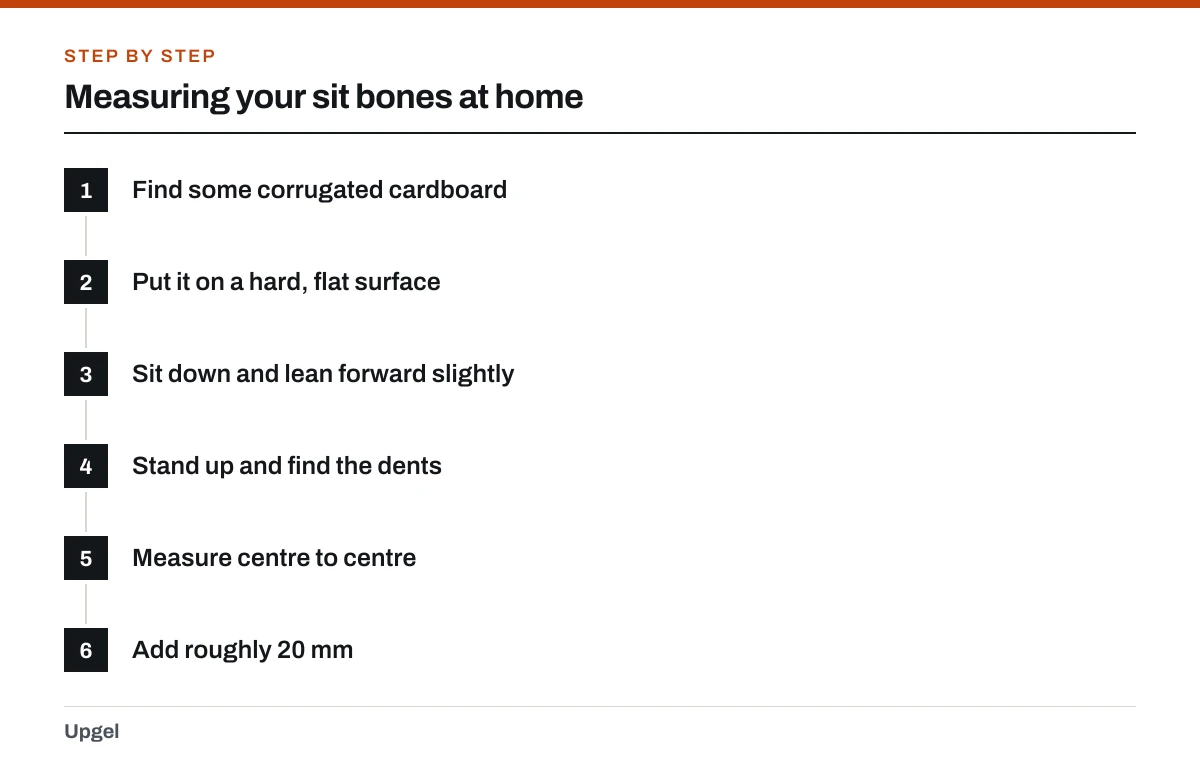
Measuring your sit bones at home
Find some corrugated cardboard
A piece of packing box, big enough to sit on.
Put it on a hard, flat surface
A stair or a hard chair. Not a sofa.
Sit down and lean forward slightly
Roughly the angle you ride at. Lift your feet briefly so all your weight goes through your sit bones.
Stand up and find the dents
Two clear impressions in the cardboard.
Measure centre to centre
That is your sit bone width.
Add roughly 20 mm
Which gives a saddle width to look for. Many bike shops have a measuring pad that does the same job in ten seconds.
Position matters as much as the saddle
Plenty of saddle pain is not caused by the saddle at all. Before buying anything, check three things.
- Height. Too low and you sit heavily with a bent leg; too high and you rock side to side, which grinds soft tissue with every stroke. Covered in adjusting bike seat height.
- Tilt. Level for most riders. Nose-up puts direct pressure on soft tissue. Nose-down slides you forward so you hold yourself up with your arms.
- Setback. Too far forward loads the narrow nose; too far back stretches you out and rotates the pelvis.
- Change one thing at a time, in small steps, and ride between changes.
Numbness is not something to push through
Research on cycling and perineal pressure has driven most modern saddle design — cutouts, relief channels and short-nose shapes all exist to reduce pressure on that region. They genuinely help many riders, though the right shape is individual.
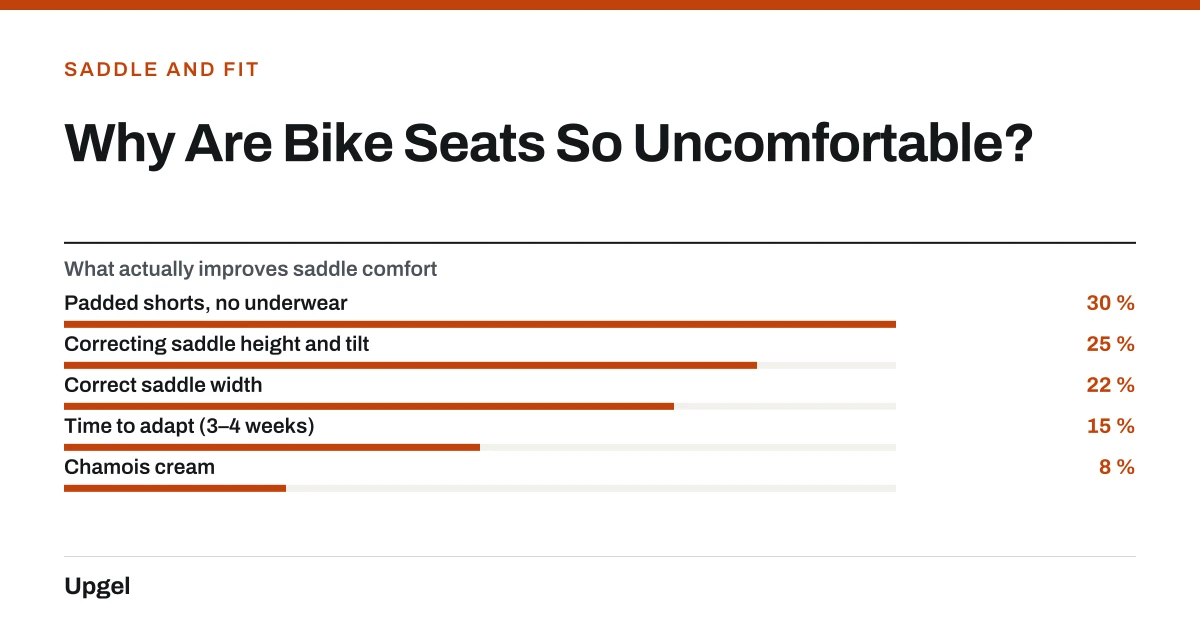
The cheapest fix is not a saddle
- Padded shorts, no underwear30%
Removes seams and reduces friction.
- Correcting saddle height and tilt25%
Free. Do this before buying anything.
- Correct saddle width22%
Measure sit bones first.
- Time to adapt (3–4 weeks)15%
Genuinely a factor for new riders.
- Chamois cream8%
For longer rides and chafing.
- Padded cycling shorts are worn without underwear. The pad is designed to sit against skin; underwear underneath adds exactly the seams the pad exists to remove.
- Chamois cream reduces friction on longer rides and helps prevent saddle sores.
- Change out of damp cycling kit promptly afterwards — most saddle sores are a hygiene problem rather than a pressure one.
- New riders do adapt. Three to four weeks of regular riding makes a real difference, provided the saddle and position are not actually wrong.
If you do need a new saddle
Measure your sit bones first, match the width to your riding position, and prefer firm over soft. It is also worth confirming the saddle is not simply loose or tilted out of position, which the check in tuning up a bike covers. Many shops run demo programmes that let you ride a saddle before committing, which is worth far more than any review — saddle comfort is more individual than almost any other component. Fitting the new one is covered in changing a bike seat.
Frequently asked questions
Why does my bike seat hurt so much?
Usually the saddle is the wrong width for your sit bones, the height or tilt is off, or you are riding in ordinary underwear instead of padded shorts. Check position and clothing before buying a new saddle.
Are wider, softer bike seats more comfortable?
Usually not. Soft padding lets your sit bones sink until soft tissue carries the load, and an over-wide saddle rubs your thighs. Firm support at the correct width is more comfortable over any real distance.
How do I measure my sit bones at home?
Sit on corrugated cardboard placed on a hard surface, lean forward slightly and lift your feet. Measure centre to centre between the two dents, then add about 20 mm to get a saddle width.
Is numbness from a bike seat dangerous?
It should not be ignored. Numbness means nerves or blood vessels are being compressed. Level the saddle, consider a cutout or short-nose design, stand up regularly, and see a fitter or doctor if it persists.
Sources
- Saddles — Sheldon Brown
Supports: Sit bone support as the basis of saddle comfort, and why excess padding and width reduce it.
- Using an Experimental Bicycle Seat to Reduce Perineal Numbness — The Physician and Sportsmedicine · DOI 10.3810/psm.2002.05.283
Supports: That saddle design measurably affects perineal numbness, which is the basis for cutout and relief-channel saddles.
- Effects of Bicycle Saddle Height on Knee Injury Risk and Cycling Performance — Sports Medicine · DOI 10.2165/11588740-000000000-00000
Supports: That saddle height affects knee loading and injury risk, and that a position set too low or too high has measurable consequences.